The Odyssey: Christopher Nolan’s Epic Reimagining of Homer’s Timeless Saga Arrives in Theaters July 17
Christopher Nolan, the visionary director behind cinematic landmarks like Inception, Interstellar, and Oppenheimer, is set to unleash one of 2026’s most anticipated blockbusters with The Odyssey. Slated for release on July 17, 2026, this grand-scale adaptation of Homer’s ancient Greek epic promises to transform a foundational story of Western literature into a breathtaking, mythic action spectacle designed for the largest screens possible. Shot entirely with cutting-edge IMAX film technology across multiple continents, Nolan’s The Odyssey blends high-stakes adventure, profound human drama, and philosophical depth, reminding audiences why some journeys transcend mere distance and become defining tests of the soul.
At its core, the film follows Odysseus (Matt Damon), the cunning king of Ithaca, on his arduous voyage home after the decade-long Trojan War. What should be a straightforward journey across the Aegean Sea stretches into ten long years of peril, divine interference, and personal transformation. Nolan’s script stays faithful to the spirit of Homer’s poem while crafting a modern cinematic language that emphasizes both the external monsters and the internal struggles of a man trying to reclaim his identity, family, and kingdom. As the tagline suggests, some journeys aren’t just about where you’re going — but what you become along the way.
Matt Damon steps into the legendary role of Odysseus, bringing the physicality and intellectual sharpness that defined his work in the Bourne series and The Martian. His portrayal captures the hero’s renowned wit and resilience alongside the weariness of a warrior haunted by loss and moral compromises. Anne Hathaway portrays Penelope, Odysseus’s steadfast wife, who fends off aggressive suitors in Ithaca while clinging to hope during her husband’s long absence. Their parallel stories — one at sea, one at home — create a dual narrative that underscores themes of loyalty, patience, and the passage of time.
Tom Holland joins as Telemachus, Odysseus’s son, whose own coming-of-age quest to find his father adds emotional layers and youthful energy to the epic. Robert Pattinson plays the villainous Antinous, the most prominent of the suitors threatening Penelope and Ithaca’s throne, delivering the kind of charismatic menace he brought to roles in The Batman. The supporting cast is stacked with heavyweight talent: Zendaya as the goddess Athena, Charlize Theron as the enchanting yet dangerous Circe (or Calypso in some reports), Lupita Nyong’o, Jon Bernthal as Menelaus, Benny Safdie as Agamemnon, Mia Goth, John Leguizamo, Himesh Patel, and Elliot Page among many others. This ensemble ensures rich character dynamics whether on the open seas or in the halls of power.
Nolan’s approach to the material emphasizes a grounded yet wondrous realism. Mythical creatures like the Cyclops Polyphemus, the seductive Sirens, and the shape-shifting threats of sorceresses are rendered with practical effects, innovative cinematography by longtime collaborator Hoyte van Hoytema, and large-format IMAX photography that makes every storm-swept wave and towering monster feel palpably real. Early footage and trailers showcase sweeping oceanic vistas, ancient battlefields still smoldering after Troy, and intimate moments of quiet desperation that highlight Nolan’s signature strength: balancing spectacle with human emotion.
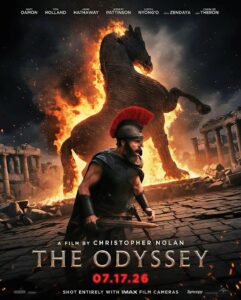
Production proved as epic as the story itself. Filmed across diverse global locations to capture authentic Mediterranean and ancient-world textures, the shoot was described by Nolan as “an absolute nightmare… but in all the right ways.” The ambitious scope required coordinating massive practical sets, complex action sequences involving ships and monsters, and the logistical challenges of large-format filming. With a reported budget around $250 million and produced by Nolan and Emma Thomas under their Syncopy banner for Universal Pictures, the film represents a major investment in event cinema. Composer Ludwig Göransson returns to craft a score that blends orchestral grandeur with ancient instrumentation for an immersive auditory experience.
What elevates The Odyssey beyond a straightforward retelling is Nolan’s fascination with time, memory, and human ingenuity. Just as Interstellar probed the boundaries of space and relativity, and Oppenheimer examined the weight of creation and destruction, this film delves into the nature of heroism, fate versus free will, and the stories we tell ourselves to survive. Odysseus’s famed cunning — from the Trojan Horse to outwitting the Cyclops — becomes a meditation on intellect as the ultimate survival tool in a world ruled by capricious gods and brutal forces. The non-linear elements of Homer’s original poem may find echoes in Nolan’s trademark narrative complexity, though the director has expressed a desire to honor the epic’s foundational storytelling power.
The homefront storyline in Ithaca receives significant attention. Penelope’s clever delaying tactics against the suitors, Telemachus’s growth into leadership, and the simmering tensions of a kingdom without its king add political intrigue and emotional stakes. This balance prevents the film from becoming purely a road movie, instead creating a rich tapestry where every delay in Odysseus’s journey carries consequences for those waiting at home. Themes of fidelity, power, and the long shadow of war resonate powerfully in today’s world, giving the ancient tale contemporary relevance.
Visually, the use of brand-new IMAX film technology promises to set a new standard. Nolan has long championed large-format projection, and bringing Homer’s saga to IMAX screens for the first time allows audiences to feel the vastness of the seas, the terror of divine storms, and the intimacy of personal confrontations in unprecedented detail. Trailers hint at kinetic action set pieces — naval battles, escapes from enchanted islands, and the climactic reckoning in Ithaca — all captured with the immersive clarity that defines Nolan’s work.
As a cinematic event, The Odyssey arrives at a moment when theaters crave bold, original spectacles. Following the critical and commercial triumph of Oppenheimer, Nolan’s return to mythic territory marks an exciting evolution. While the film embraces fantasy elements, it grounds them in emotional truth and philosophical inquiry rather than pure escapism. Viewers can expect the trademark Nolan hallmarks: intricate plotting, impeccable production design, and performances that elevate genre material into something profound.
The journey of Odysseus has inspired countless adaptations over millennia, from ancient plays to modern novels and films. Nolan’s version stands apart through its commitment to scale, technical innovation, and a star-studded cast capable of carrying both the intimate and the monumental. It explores what it means to endure when gods and monsters conspire against you, when home feels like a distant dream, and when the greatest battle may be reclaiming one’s humanity after years of conflict.
With its July 17 release, The Odyssey is positioned as a true summer event — the kind of film that demands to be seen on the biggest screen possible. Whether you’re drawn to the mythic creatures, the all-star performances, the groundbreaking visuals, or Nolan’s signature intellectual depth, this epic reimagining delivers on the promise of cinema as a transformative experience. Some stories never age, and under Nolan’s direction, Homer’s tale feels more vital and urgent than ever. Prepare for a voyage that will test heroes, stir emotions, and leave audiences reflecting on their own paths long after leaving the theater. This is not just a journey home — it is a cinematic odyssey worth every mile.