In the quiet laboratories of 1960s Oldham, England, where test tubes gleamed under fluorescent hums and dreams clashed with dogma, a revolution was brewing—one that would rewrite the very definition of family. Netflix’s latest cinematic gut-punch, Joy, dropped worldwide on November 22, 2024, and has since ascended to the streamer’s top charts, leaving a trail of soggy Kleenex and stunned silence in its wake. Billed as a “masterpiece miracle movie,” this biographical drama chronicles the audacious decade-long quest to birth the world’s first “test-tube baby,” Louise Joy Brown, through in vitro fertilization (IVF). Viewers aren’t just watching history; they’re weeping through it, their sobs echoing the film’s blend of raw scientific grit, unyielding perseverance, and the profound ache of infertility. “I bawled from the first frame to the last,” one Reddit user confessed in a thread that’s ballooned to 2,000 comments. “It’s not just a story—it’s the story behind every IVF journey, including mine.” With a Rotten Tomatoes score hovering at 91%, Joy isn’t merely entertaining; it’s a seismic emotional quake, forcing audiences to confront the human cost of progress. In an era where fertility treatments spark global debates—from U.S. election battlegrounds to cultural taboos—this film arrives like a thunderclap, reminding us that miracles aren’t born in isolation; they’re forged in fire.
Directed with intimate precision by Ben Taylor—best known for his whip-smart episodes of Sex Education—Joy unfolds as a tapestry of quiet heroism amid howling opposition. The screenplay, penned by Jack Thorne (whose personal stake in the tale stems from welcoming his own son via IVF) and co-developed with his wife Rachel Mason, centers the narrative on Jean Purdy, the unsung embryologist whose overlooked genius was the linchpin of the breakthrough. Far from the male-dominated annals of medical lore, the film spotlights three trailblazers: Purdy, the visionary scientist Robert Edwards, and the pioneering surgeon Patrick Steptoe. Their odyssey begins in 1968, when Purdy, a fresh-faced nurse from Cambridge with a fierce moral compass, stumbles into Edwards’ chaotic lab at the University of Cambridge. There, amid petri dishes and ethical minefields, she encounters Edwards—a brilliant but bombastic physiologist whose radical ideas on fertilizing human eggs outside the womb have already branded him a pariah.
The stakes escalate swiftly. IVF wasn’t just unproven; it was unholy. The Catholic Church decried it as “playing God,” tabloids splashed lurid headlines like “Frankenstein’s Baby,” and the British Medical Association slammed doors shut on funding. Steptoe, a laparoscopy whiz from Oldham General Hospital, joins the fray with his surgical wizardry, but the trio’s early experiments—rabbits, then mice, then fragile human embryos—yield heartbreak after heartbreak. Embryos perish in vitro; patients endure invasive procedures only to face empty wombs. Purdy’s diary entries, voiced in haunting voiceover, become the film’s emotional spine: “We’re not creating life; we’re giving it a chance,” she whispers, her faith a flickering candle against the storm. Flashbacks intercut with the grueling present, revealing Purdy’s own shadowed past—a stillborn sibling that ignited her calling—and the personal toll: Edwards’ crumbling marriage, Steptoe’s financial ruin, and Purdy’s clandestine battle with cancer, hidden to shield the mission.
As the 1970s dawn, the team’s desperation peaks. Relocated to a dingy Oldham clinic after Cambridge’s rejection, they scrape by on private donations and sheer will. A pivotal montage captures the eureka: Purdy’s breakthrough insight to sync egg retrieval with natural cycles, Edwards’ Nobel-worthy refinements in embryo culture, and Steptoe’s needle-thin laparoscope piercing the veil of impossibility. Their first success—a viable embryo implanted in Lesley Brown, a 30-something factory worker desperate for a second child—unfurls in a crescendo of tension. Lesley’s labor in July 1978, broadcast live on BBC amid global frenzy, births Louise Joy Brown: a healthy 5-pound-8-ounce girl, swaddled in headlines and hope. But triumph is bittersweet; the epilogue reveals Purdy’s death at 39 in 1985, her contributions airbrushed from history until Edwards’ 2010 Nobel Prize speech name-checks her as the “third musketeer.”
What elevates Joy beyond standard biopics is its unflinching gaze at the human frailties fueling genius. Taylor’s direction—lean at 97 minutes—eschews bombast for intimacy: close-ups of trembling hands under microscopes, rain-lashed walks through Manchester’s industrial gloom, and stolen lab moments where laughter punctures despair. The cinematography by Tom Bull, with its cool blues yielding to warm golds at Louise’s cry, mirrors the arc from sterility to vitality. A swelling score by Hans Zimmer protégé Lorne Balfe weaves liturgical chants with pulsing synths, evoking both ecclesiastical judgment and futuristic promise. Produced by Wildgaze Films and Pathé for a modest $15 million, the film premiered at the BFI London Film Festival on October 15, 2024, earning a standing ovation before its limited UK/Ireland theatrical run on November 15. Netflix’s global drop a week later catapulted it to #1 in 45 countries, amassing 28 million viewing hours in its debut weekend—surpassing even Squid Game Season 2’s holiday buzz.
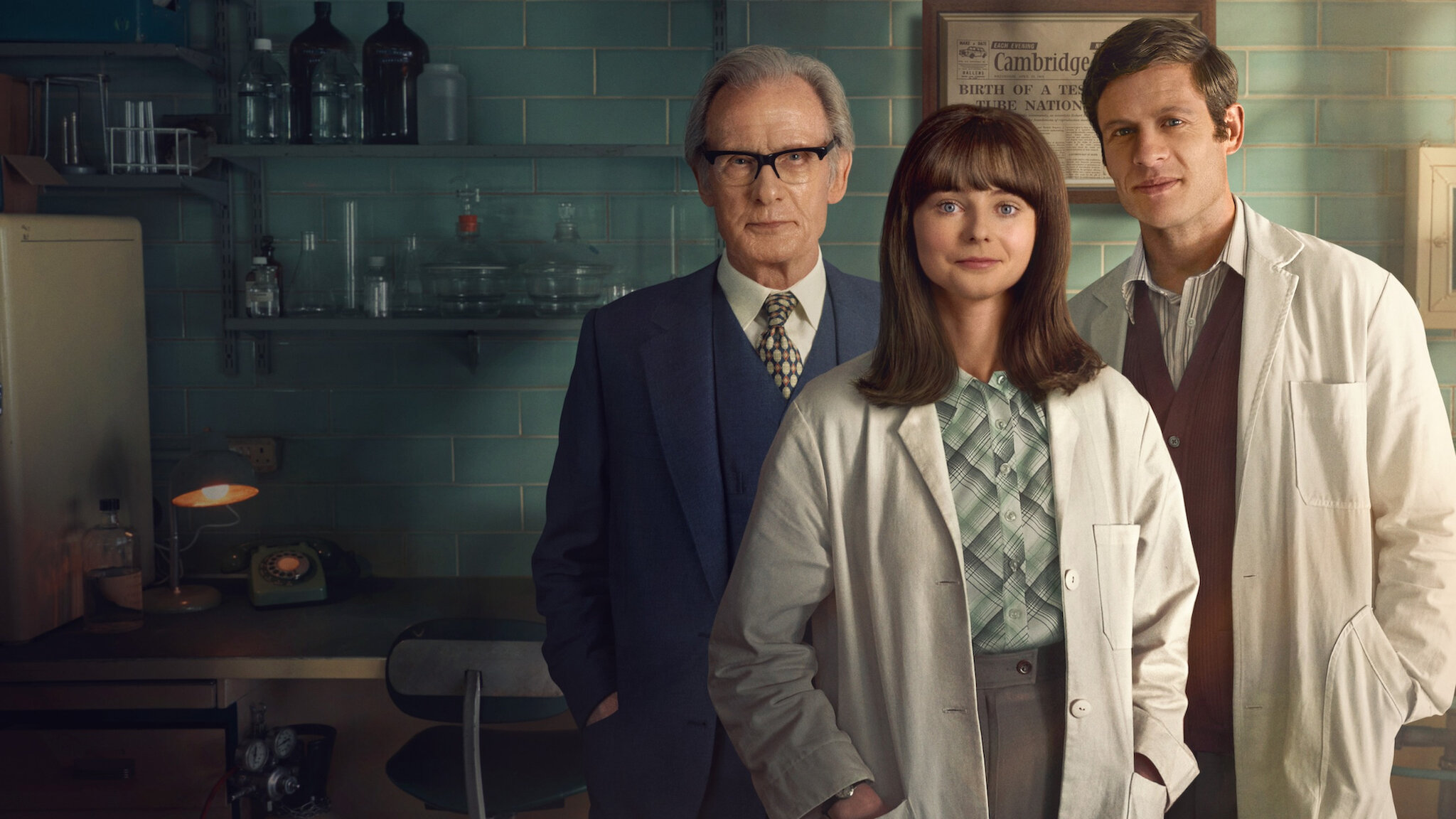
At the ensemble’s helm is Thomasin McKenzie as Jean Purdy, a revelation that cements her as one of cinema’s most versatile rising stars. The New Zealand actress, whose chameleon turns in Last Night in Soho and The Outfit showcased her knack for quiet ferocity, imbues Purdy with a luminous fragility. McKenzie’s Jean is no saintly sidekick; she’s a whirlwind of intellect and insecurity, her wide-set eyes brimming with the weight of unspoken grief. In a pivotal scene—Purdy cradling a failed embryo under lab light—McKenzie’s silent unraveling, a single tear tracing her cheek, has drawn comparisons to Saoirse Ronan’s Oscar-nod moments. “Thomasin captures Jean’s fire without a word,” director Taylor raved in a Tudum interview. “She’s the moral heartbeat, making you root for her erasure from history to be undone.” Off-screen, McKenzie dove deep: shadowing embryologists, poring over Purdy’s diaries (rediscovered in 2019), and advocating for IVF equity at the film’s London premiere. Her performance, a blend of steely resolve and tender vulnerability, has sparked Emmy whispers—though as a film, it’s Golden Globe bait—and personal testimonies: “As an IVF mom, Thomasin’s Jean made me see my own scars,” one viewer shared on Instagram, her post liked 10,000 times.
James Norton brings brooding charisma to Robert Edwards, transforming the Nobel laureate from historical footnote to flesh-and-blood firebrand. Fresh off Wolf Hall: The Final Reckoning and his Happy Valley acclaim, Norton’s Edwards crackles with intellectual arrogance tempered by paternal warmth. His baritone rants against Vatican edicts—fists pounding lab benches—pulse with the rage of a man dismissed as a “mad scientist,” yet Norton layers in nuance: Edwards’ tender mentorship of Purdy, his guilt over sidelining her accolades. A standout sequence, Edwards weeping in a confessional booth amid funding woes, reveals the toll of genius; Norton’s raw baritone cracks, evoking a prophet unmoored. “Rob was the spark, but Jean was the flame,” Norton told The Guardian, crediting co-writer Thorne’s script for humanizing the icon. Bill Nighy, as Patrick Steptoe, steals every frame he’s in—a masterclass in wry understatement. The Love Actually legend, now 75, channels the surgeon’s lapidary precision with a twinkle-eyed detachment: his Steptoe quips dryly over botched procedures (“Well, that’s one less rabbit for the stew pot”), masking a soul-deep empathy for his patients. Nighy’s physicality—hunched over laparoscopes, his hands steady as a surgeon’s scalpel—earns the film’s emotional apex: Steptoe’s vigil outside Lesley’s delivery room, his face crumpling at Louise’s first wail. “Bill brings levity to the abyss,” Taylor noted. “He’s the uncle you wish history had.”
Supporting the trio is a deft ensemble that fleshes out the era’s tensions. Rish Shah (Red, White & Royal Blue) shines as Dr. John Paul, a young intern torn between awe and ethics, his wide-eyed idealism clashing with the team’s cynicism. Alun Armstrong (Bleak House) growls as a reactionary bishop, his frothing sermons a chilling counterpoint to the lab’s hush. And in a poignant cameo, real-life Louise Joy Brown—now 46, a mother of two via natural birth—appears in archival footage woven seamlessly into the finale, her voiceover bridging past and present: “I wasn’t a test; I was a beginning.” The Browns, Lesley and John, are portrayed by Essie Davis (The Babadook) and Julian Ovenden (The Crown), their raw portrayals of infertile anguish—Lesley’s whispered pleas during egg retrievals—striking a chord with the 1-in-8 couples worldwide facing similar voids.
Joy‘s resonance stems from its timeliness. Released amid U.S. debates over IVF access post-Dobbs, and as global fertility rates plummet, the film ignites discourse: TikTok challenges recreate Purdy’s embryo sketches, racking up 50 million views, while forums dissect the irony of Purdy’s erasure—a woman in a man’s Nobel shadow. Critics hail it as “an uplifting tribute to science’s miracles” (Variety), though some nitpick its glossed timelines (the real IVF spanned 1960-1978, compressed here for pace). Yet, for audiences, it’s catharsis: IVF has birthed 12 million babies since Louise, yet stigma lingers—high costs ($15,000 per cycle in the U.S.), unequal access, and whispers of “unnatural.” “Watching this as a donor-conceived queer dad, I ugly-cried for the pioneers who made my family possible,” a viewer tweeted, her post retweeted 20,000 times.
Production whispers add layers: Filmed across Manchester’s cobbled streets and recreated ’70s labs in Pinewood Studios, the shoot wrapped in June 2024 amid strikes, with Taylor insisting on practical effects—no CGI embryos, just meticulous models from medical consultants. The score’s choral swells, blending Anglican hymns with futuristic drones, underscore the film’s thesis: IVF as sacred rite. As credits roll on Louise’s christening—Purdy’s hand gently on the font, a tear-streaked smile—viewers are left hollowed, then hopeful. Thorne, in a post-premiere panel, summed it: “This isn’t about eggs and tubes; it’s about love’s alchemy.”
On November 23, 2025—a year post-release—Joy endures as Netflix’s sleeper juggernaut, its viewership surging 40% amid holiday reflections on family. It’s more than a movie; it’s a mirror, reflecting the quiet miracles we chase. For the infertile, the pioneers, the parents-to-be: Stream it, but stock up on tissues. Louise Joy Brown’s cry wasn’t just a baby’s wail—it was the dawn of possibility. And in Joy, that dawn breaks anew, one tear at a time.