“So, You Just Fax Things For The Military?” My Uncle Sneered. I Sipped My Water. “No. I Fly.” He Snorted. “What’s Your Call Sign?” I Said, “Reaper Queen.” He Went Silent…
“So, You Just Fax Things For The Military?” My Uncle Sneered. I Sipped My Water. “No. I Fly.” He Snorted. “What’s Your Call Sign?” I Said, “Reaper Queen.” He Went Silent…
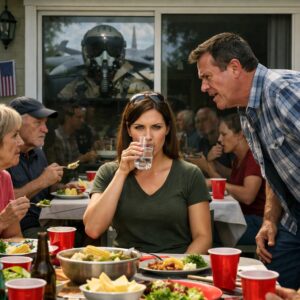
July heat settled over the mountains like a heavy blanket. By the time I turned onto Uncle Raymond’s gravel driveway, my palms were slick on the steering wheel and my T-shirt clung to my back. I could hear the party before I saw it: country music from a portable speaker, kids shrieking between pine trunks, the steady sizzle of meat on an overworked grill.
Every summer was the same ritual. String lights zigzagged from the porch to fence posts. Folding tables wore red-and-white cloths. Coolers of beer lined the deck rail. And Raymond Reeves—my mother’s older brother, my uncle, the man who’d once seemed larger than life—stood at the grill with tongs in one hand and a drink in the other, commanding the backyard like it belonged to him.
I parked where I always did, on the edge of the lawn near the woodpile, and sat for a beat with the engine off. It’s just one afternoon, I told myself. Smile. Eat. Leave early. Keep the peace.
That was what Tatum Reeves always did. I arrived late enough to avoid attention. I carried a store-bought pie so no one could accuse me of showing up empty-handed. I laughed when I was supposed to. I kept my life in vague phrases that fit into their world.
When I stepped into the backyard, smoke and sweet barbecue sauce clung to the air. Cousins I saw twice a year called my name and hugged me with sticky fingers. Someone shoved a paper plate into my hand. I drifted through the crowd like I belonged, which isn’t the same as actually belonging.
“Hey, Tat!” my cousin Lacey shouted from the cornhole boards. “Still up in Washington doing… plane stuff?”
“Still doing plane stuff,” I said, and hated how small it sounded.
I made it to the table, loaded my plate with potato salad and ribs, and hoped—foolishly—that Raymond wouldn’t notice me. But he always did. It was part of the script.
When he finally looked up from the grill, his smirk was already waiting. “There she is,” he boomed. “Our little aerospace genius.”
A few heads turned. A few people smiled like they expected entertainment.
Raymond lifted his glass toward me, elbow cocked, eyes bright with that familiar mix of charm and challenge. “Designing planes isn’t flying them, Tatum,” he said, loud enough for everyone to hear. “Anyone can draw a pretty picture. Doesn’t mean you could handle the real thing.”
Laughter erupted around the picnic table—easy, comfortable laughter that said we know who belongs here. I felt the words land in my chest like a blunt object. He’d been doing it for years, ever since I’d left for college and come back with degrees he didn’t know how to measure. But this time it cut sharper, maybe because I was older now, and tired of shrinking.
I smiled anyway. My face knew how, even when my body didn’t want to. I lifted my plastic cup in return, a gesture that said no harm done, keep going, don’t look too closely.
Inside, something cracked. Not loudly. Not visibly. Just deep enough to change the shape of me.
A helicopter passed over the ridge just then, low enough that the pine branches trembled. The rotor thrum rolled across the yard—steady, mechanical, familiar—and something in my ribs answered like a tuning fork. I looked up automatically, tracking it until it disappeared behind the trees.
No one else bothered. To them it was just noise. To me it was a reminder of the world I lived in most days, the world where precision mattered and mistakes had names.
Raymond followed my gaze and snorted. “See? That’s flying,” he said. “That’s what matters.”
I swallowed the heat rising in my throat and took a bite of rib I couldn’t taste.
The afternoon slid by in snapshots: my mother laughing too brightly at Raymond’s stories; my aunt calling me sweetheart; cousins arguing about football; Raymond gesturing with his tongs like he was still giving orders. I kept my smile in place. Silence, I’d learned, could be armor.
But as the sun dropped behind the mountains and the string lights flickered on, a promise formed in me with a clarity that scared me.
One day, I thought, he’s going to find out who I really am.
The silence stretched longer than the low rumble of that departing helicopter. Raymond’s smirk froze, then slowly collapsed. The tongs in his hand dipped; a drop of grease hissed on the grill.
“Reaper Queen,” he repeated, quieter now, like he was testing the words for a trap. A nervous chuckle escaped him. “That’s… cute. Sounds like something from one of those video games the kids play.”
I set my cup down carefully. The plastic made a small, final sound against the table.
“It’s not cute,” I said. “It’s earned.”
Someone—maybe Lacey—let out an awkward laugh that died fast. The country music kept playing, but it felt distant, like it was happening in another yard.
Raymond wiped his hands on the apron stretched across his belly. “Come on, Tat. You’re telling me you’re out there flying… what? Drones? Cargo planes? Some desk job with wings?”
I met his eyes. “MQ-9 Reaper. Armed. Remotely piloted at first. Then transitioned to cockpit. F-35 now. Carrier-qualified last year.”
The names landed like stones in still water. Ripples spread. A few cousins exchanged glances. My mother stopped mid-sentence with Aunt Carla, her smile faltering.
Raymond opened his mouth, closed it. Then he tried again. “Bullshit.”
I didn’t flinch. “Check the news archives. Three years ago. Operation Midnight Harvest. Single pilot took out a high-value target convoy in the mountains near the Afghan-Pakistan border. Zero civilian casualties. Fourteen-hour sortie in weather that grounded everyone else. The strike package called her Reaper Queen on the comms because she wouldn’t let the weather or the SAMs turn her back.”
I let that sit.
“Then last winter,” I continued, “South China Sea. Night trap on the Ford in thirty-knot crosswinds. Deck pitching twenty feet. I brought my bird back with half the hydraulics shot out and thirty seconds of fuel. The LSO said it was the prettiest ugly landing he’d ever seen.”
Raymond’s face had gone the color of old ash. He looked at me like he was seeing someone else’s niece.
I pulled my keys from my pocket. On the ring hung a small matte-black tag—the kind they don’t issue to desk jockeys. A silver crown etched above block letters: REAPER QUEEN.
I dropped it on the table between us. It clinked once, then lay still.
“Next summer,” I said, “if you want, I’ll bring the helmet cam footage. Or the citation. Or we can just eat ribs and pretend I still fax things. Your call.”
He stared at the tag for a long beat. Then he reached out—slow, almost careful—and picked it up. His thumb traced the letters like Braille.
When he spoke, his voice was rough, smaller than I’d ever heard it.
“I flew Hueys in ‘Nam,” he said. “Lost my co-pilot over the A Shau. Never got a fancy name for it. Just… kept going.”
He looked up at me. Something cracked in his expression—not anger. Recognition.
“I thought you were safe,” he said. “Paperwork. Plans. Not this.”
“I was never safe,” I answered. “I just didn’t tell you.”
He handed the tag back. His hand shook a little.
“Next time you come,” he said, “bring that footage. And… stay longer. Tell the kids what it’s really like.”
I nodded once.
The party noise crept back in slowly—laughter, a cork popping, someone cranking the music. But the air felt different. Lighter, somehow. Like the heavy blanket of July heat had finally lifted.
I took a real bite of rib this time. It tasted like smoke, salt, and something close to forgiveness.
As the stars came out over the ridge, a jet traced a thin white line high above us—too far to hear, but I knew the sound it would make up close. I tracked it until it vanished.
Raymond watched it too.
For once, he didn’t say a word.
He just raised his glass toward the sky.
To the quiet ones, I thought.
To the ones who fly.