Netflix’s Disturbing 6-Part Thriller With a Perfect Score Is Quietly Becoming the Most Addictive, Unsettling Binge You’ll Regret Starting Midweek!
Tucked away in Netflix’s vast library since its September 2023 release, Dear Child (original German title Liebes Kind) has resurfaced as a sleeper hit that’s leaving viewers rattled, sleepless, and utterly hooked. This six-episode German psychological thriller, based on Romy Hausmann’s international bestselling novel, carries an 18+ rating for its “intense psychological horror” and disturbing themes—yet it boasts a rare perfect 100% critics’ score on Rotten Tomatoes from its initial reviews, with an impressive audience Popcornmeter in the low 80s. Critics have hailed it as a “thrilling and twisted watch,” while fans on social media describe it as “captivating,” “disturbing,” “impossible to stop watching,” and the kind of series that turns a casual midweek start into an all-night obsession that leaves you wide awake at 3 a.m., questioning every shadow.
The story opens with a shocking scene: a woman (Kim Riedle) flees a windowless, highly secured house in a remote northern German forest, accompanied by a young girl named Hannah (Naila Schuberth). Moments later, she’s struck by a car in a hit-and-run accident. The woman, severely injured, is rushed to the hospital, where she insists her name is Lena and that Hannah is her daughter. But nothing adds up. Police detective Gerd Bühling (Hans Löw), haunted by an unsolved missing persons case from 13 years earlier—the disappearance of teenager Lena Beck—begins to connect the dots. The escaped woman claims to be Lena, yet her story is riddled with inconsistencies, and the children she mentions include a boy, Jonathan (Sammy Schrein), who isn’t with her.
As investigators dig deeper, the series masterfully interweaves the present-day probe with chilling flashbacks to life inside the captivity. The three captives—referred to as Lena, Hannah, and Jonathan—live under the iron rule of a faceless captor whose face remains hidden for much of the series. He enforces rigid routines: precise meal times, hand inspections upon entry, no crying, no deviation. The children are conditioned to obedience, addressing him with deference and following commands without question. The woman, forced to assume the identity of “Lena” (her hair dyed blonde, her real name Jasmin Grass erased), must care for the kids while enduring psychological torment, isolation, and abuse. The captor’s control is absolute—he knows every move, monitors everything, and punishes any infraction with calculated cruelty.
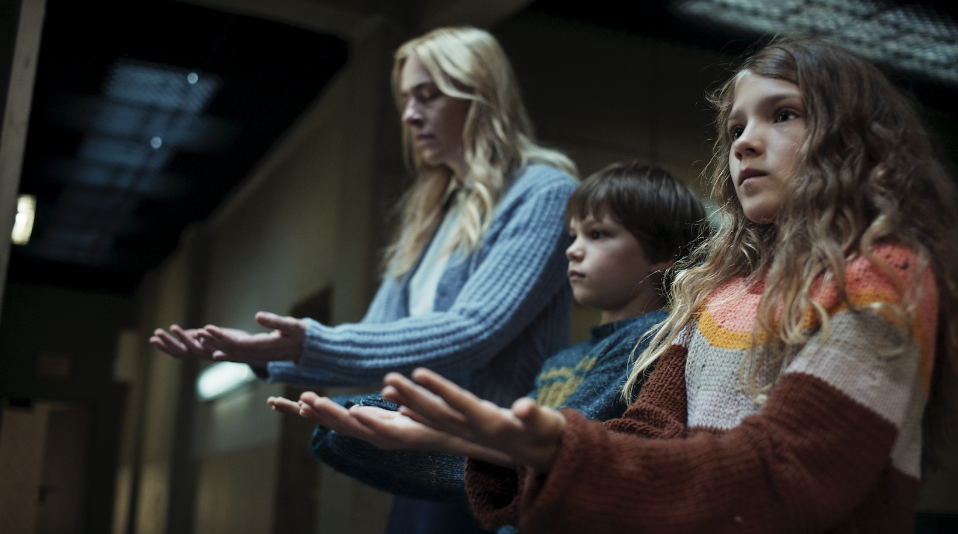
The narrative unfolds as a puzzle of timelines and perspectives. In the present, Bühling and his team question the escaped woman, interview the children (Hannah remains eerily composed and articulate, reciting rules and stories that unsettle everyone), and revisit the old Beck case. Lena Beck vanished at 13, leaving her parents (Justus von Dohnányi and Julika Jenkins) in endless grief. Flashbacks reveal how Jasmin was abducted from a parking garage, renamed, and trapped in this nightmare existence for months (or longer, depending on revelations). The children, raised entirely in captivity, know no other world—their “father” is the center of their universe, their routines a warped sense of normalcy.
What elevates Dear Child beyond standard thrillers is its psychological depth and slow-burn dread. The series excels at building suffocating tension through atmosphere: dim lighting in the confined house, the constant ticking of clocks enforcing schedules, the children’s robotic compliance that grows more horrifying with each revelation. Performances are outstanding—Kim Riedle conveys layers of trauma, resilience, and confusion as the woman whose identity blurs between victim and assumed role. Naila Schuberth’s Hannah is particularly chilling: a child who speaks with unnatural poise, reciting rules and protecting “Papa,” yet showing flickers of innocence and fear. The supporting cast, including Haley Louise Jones and Birge Schade, adds emotional weight to the families shattered by the events.
Twists arrive relentlessly, each one peeling back layers of deception. Viewers are kept guessing about identities, motives, and truths—nothing is as it seems. The captor’s identity, revealed in the finale, ties everything together in a shocking yet logical way: Lars Rogner (Christian Beermann), a seemingly ordinary local surveillance expert who’s lived in plain sight while orchestrating horrors. The resolution addresses the central mysteries—the connection between the escapees and the Beck disappearance—while delivering emotional closure laced with unease. Some fans praise the ending for its eerie completeness; others call it rushed or leaving lingering questions, but the consensus is that the journey is worth every sleepless night.
Adapted for screen by directors/writers Isabel Kleefeld and Julian Pörksen, Dear Child captures the novel’s essence: a blend of crime procedural, family drama, and psychological horror. It explores trauma’s long shadows, the fragility of memory, the devastating impact of control and isolation, and how evil can hide behind normalcy. The German setting—forested isolation, meticulous police work—adds authenticity and cultural nuance.
Social media reactions underscore its addictive power. Fans post warnings: “Started as a quick watch… now it’s 3 a.m. and I’m traumatized.” Others rave: “One of the best binges in years,” “edge-of-your-seat from start to finish,” “mind-blowing twists.” Many highlight its realism without gratuitous gore—focusing on psychological terror over violence. It’s climbed Netflix charts multiple times, proving its staying power even years later.
If you’re drawn to dark, intense thrillers like The Undoing, Your Honor, or The Girl with the Dragon Tattoo, Dear Child is essential. Six episodes fly by in a haze of suspense, dread, and revelation. But heed the warnings: don’t start midweek unless you’re prepared for restless nights and a lingering sense of unease. Once you begin, switching off becomes impossible—and regretting it might be the least of your worries.