My Father, The Admiral, Announced His New Wife’s Daughter As The “Youngest Commander Ever.”
My Father, The Admiral, Announced His New Wife’s Daughter As The “Youngest Commander Ever.” They Were Celebrating, Champagne In Hand, When I Entered In Full Uniform. The Crowd Went Silent. His Glass Slipped. “Who Approved This Rank?!” He Shouted. My Family Utterly Stunned.
The first thing that broke was the glass.
It slid from my father’s hand the moment his eyes found me at the back of the hall, as if gravity itself had waited for his recognition. A champagne flute hit the polished floor of the Washington Navy Yard reception room and shattered with a crack sharp enough to stop every voice mid-syllable. Bubbles spread across the marble like spilled applause.
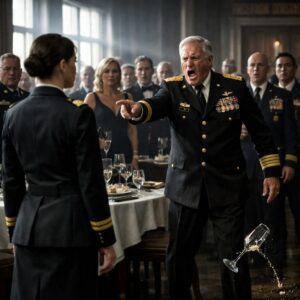
“Who authorized that rank?” Admiral Robert Green repeated, louder this time, the words slicing through the silence like a hull breach. His face had gone from carved stone to something rawer—confusion warring with fury.
I stopped five paces from the stage, came to attention with parade-ground precision, and rendered the sharpest salute I’d ever given in my life.
“Commander Michelle Green, reporting as ordered, sir.”
The room exhaled in fragments: a gasp here, a murmured “Holy hell” there, the soft click of phone cameras still recording because no one had the presence of mind to stop.
Elise’s smile had frozen completely now. Her eyes flicked from my shoulder boards to my father’s face and back again, calculating odds the way she always did. She looked suddenly much younger than her twenty-eight years.
My father recovered first—of course he did. He stepped away from the podium, voice dropping to the register he used in classified briefings. “Michelle. Explain yourself. Now.”
I lowered my salute, hands returning to my sides. “There’s nothing to explain, Admiral. The Secretary of the Navy signed the promotion order three weeks ago. PERS-802 processed it last Tuesday. I took the oath in Norfolk yesterday morning.”
A ripple moved through the crowd—officers exchanging glances, civilians whispering furiously. Someone near the camera crew muttered, “Below-the-zone?”
“Twice,” I said, loud enough for the front row to hear. “Selected below-the-zone to lieutenant commander at eight years commissioned service. Below-the-zone again to commander at twelve. The board cited exceptional performance in contested environments, including two combat deployments and command of a destroyer escort during the South China Sea freedom-of-navigation operations last year.”
Elise’s champagne hand trembled, just enough to send a few drops over the rim. “That’s impossible,” she said, almost to herself. “You can’t—you’re not even—”
“Eligible?” I finished for her. “The minimum time-in-grade for O-5 is three years as lieutenant commander, and cumulative service of roughly fifteen to seventeen years. I hit sixteen years and four months last month. The Navy waived nothing. They accelerated nothing. They simply recognized results.”
My father’s jaw worked. He had spent his entire career preaching meritocracy, the cold purity of performance over politics. Now the words were coming back at him like shrapnel.
“You never told me,” he said. It wasn’t an accusation anymore; it was almost a plea.
“You never asked.”
The silence stretched. Then a single voice broke it—an older rear admiral near the bar, someone who had served with my father since they were both lieutenants.
“Congratulations, Commander Green.” He raised his glass. “To the youngest serving O-5 in the active Navy. And to the family that raised two of them.”
A few others lifted their glasses uncertainly. The spell cracked.
Elise set her flute down with careful deliberation. She looked at my father, then at me. For the first time since the wedding three years earlier, there was no performance in her expression—just quiet assessment.
“I underestimated you,” she said. Not an apology, but close enough.
My father closed the distance between us in three strides. He studied my face the way he used to when I was a child bringing home report cards he pretended not to care about. Then, slowly, he lifted his right hand.
Not in salute.
He placed it on my shoulder, thumb brushing the silver oak leaf as though testing its reality.
“Commander,” he said, voice rough. “Well done.”
He turned to the room, shoulders squaring the way they did before every difficult order.
“Ladies and gentlemen,” he announced, “it appears tonight’s celebration just doubled in scope. We are honoring not one, but two commanders in this family. Elise—and Michelle. Both earned. Both deserved.”
The applause started hesitantly, then built. Not the polished wave from before—this one had edges, real surprise, real respect.
Elise stepped forward first. She extended her hand. “Stepsister,” she said quietly.
I took it. “Commander.”
My father watched us shake hands under the chandelier light, the two silver oak leaves catching fire in the same glow. For once, he didn’t speak. He simply nodded—once, sharply—like a man who had just received the sitrep he hadn’t known he needed.
Later, after the toasts, after the photographs that would run on every Navy Times front page for a week, after the crowd thinned and the staff began clearing shattered glass and half-empty flutes, my father found me on the balcony overlooking the Anacostia.
He handed me a fresh glass of champagne. “I thought I was building a legacy,” he said. “Turns out I was just providing the starting line.”
I took a sip. “You taught us both the same thing, Dad. Results over everything.”
He looked out at the river, lights trembling on black water. “I pushed Elise because I saw myself in her—polished, connected, safe. I didn’t push you because I thought you’d break if I did.”
“I didn’t break,” I said.
“No.” He turned to me, eyes steady again. “You outran us both.”
We stood in silence a long time. The Navy Yard lights reflected in the water like scattered stars.
“Proud of you, Commander,” he said at last. Simple. No rank between us.
I smiled—small, real. “Proud of you too, Admiral.”
He raised his glass.
“To the youngest commander,” he said.
I clinked mine against his. “And to the next one.”
Somewhere inside, the music started again—soft, tentative, like the beginning of something new.