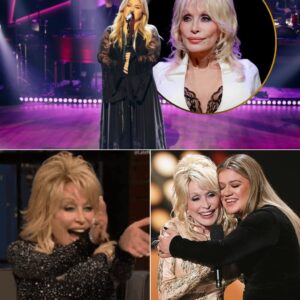
Kelly Clarkson and Vince Gill brought the 59th Annual CMA Awards to a quiet standstill on Wednesday night with a stripped-back, heartfelt performance of “Don’t Rush” that felt more like a private family moment than a televised awards-show number.
The two singers walked onto the Bridgestone Arena stage with minimal production—no elaborate set, no backup band, no dramatic lighting. Just two microphones and Gill’s acoustic guitar. Clarkson opened the song in a soft, restrained register, her voice carrying an intimacy that contrasted sharply with the powerhouse belts she is known for. Gill entered with his signature smooth tenor, the two voices weaving together in near-perfect harmony from the first chorus onward.
The performance was simple, direct, and emotionally unguarded. Clarkson sang with her eyes mostly closed, fully immersed in the lyrics of longing and second chances. Gill remained steady beside her, providing gentle guitar support and harmonies that never overpowered her lead. The restraint on both sides made the song feel even more powerful; every note landed with purpose and vulnerability.
What elevated the moment beyond a strong musical collaboration was the reaction shot repeatedly captured by the broadcast cameras: Reba McEntire, seated in the front row directly below the stage.
Throughout the performance, McEntire watched with a soft, glowing smile and visibly shining eyes. Her hands stayed clasped in her lap as she followed every line, every harmony, never looking away. The expression on her face was unmistakable—quiet pride, affection, and something deeper that carried the weight of shared history.
McEntire was once Clarkson’s mother-in-law. Clarkson was married to Brandon Blackstock, McEntire’s stepson, from 2013 to 2020. The couple shares two children, River Rose and Remington “Remy” Blackstock. Although the marriage ended, the two women have maintained a respectful public distance, focusing on co-parenting without drama or public conflict.
Seeing McEntire in the front row, openly emotional as Clarkson sang, created a powerful subtext. The camera lingered on her several times during the song, and each cut drew an almost audible collective breath from the audience. When the final note faded, the arena erupted into a prolonged standing ovation that felt more personal than ceremonial.
Clarkson and Gill exchanged a brief, understated hug before walking offstage. McEntire continued clapping slowly, her smile lingering even after the lights shifted.
In the hours following the broadcast, clips of the performance—and especially McEntire’s reaction—spread rapidly across social media. Fans shared side-by-side stills, screen recordings, and emotional captions: “Reba watching Kelly like a proud mom,” “This healed something in me tonight,” “No words needed—just love.” The moment trended quickly under hashtags tied to the CMA Awards and the song title.
Clarkson later posted a simple thank-you on her social channels, sharing a photo from the stage with Gill and writing: “Grateful for this song, for Vince, and for everyone who felt it with us tonight.” McEntire reposted the same clip with a single word: “Beautiful.”
The duet was a standout in an evening filled with high-profile performances and major wins. “Don’t Rush,” originally recorded by Kelly Clarkson as a bonus track on her 2011 album Stronger, became a quiet fan favorite for its understated heartbreak. Pairing it with Gill, one of country music’s most respected vocalists and harmony singers, gave the song new life on a major stage.
![Kelly Clarkson and Vince Gill Perform “Don't Rush” During the 46th Annual CMA's Show [VIDEO]](https://townsquare.media/site/114/files/2012/11/155123859.jpg?w=780&q=75)
The choice of song, the understated arrangement, and the presence of McEntire in the front row combined to create a moment that transcended typical awards-show spectacle. It was a reminder that behind the glamour, country music still has room for real emotion, shared history, and unspoken understanding.
For three minutes on Wednesday night, the CMA Awards stage became something smaller and more meaningful: a space where two great voices honored a song, and where a former mother-in-law watched with open, quiet love as the mother of her grandchildren sang from the heart.
The ovation lasted long after the lights came back up.