ITV’s newest six-part police thriller is already being hailed as a “gripping” and “deeply chilling” mystery. When the wife of a respected headmaster vanishes without a trace, he becomes the prime suspect — and the elite private school he leads quickly unravels into a maze of buried secrets, quiet scandals, and lies that reach far deeper than anyone imagined. With stars from Sherwood and Downton Abbey, this is the psychological drama every crime fan is talking about. Dropping on ITV1 and ITVX in early 2026, Gone—penned by the razor-sharp George Kay (Hijack, Lupin)—isn’t just a whodunit; it’s a scalpel slicing through the veneers of privilege, exposing the rot beneath ivy-covered walls and whispered corridors. Directed by Richard Laxton (The Thief, His Wife and the Canoe), it transforms Bristol’s foggy sprawl and a foreboding forest into a pressure cooker of paranoia, where every polished handshake hides a clenched fist. Social media is ablaze with pre-buzz: “If Broadchurch broke your heart, this will shatter it—Eve Myles is a force,” one viewer speculated after leaked set photos. Another dubbed it “The Sinner meets Succession in a school tie.” At 60 minutes per episode, it’s a binge that burrows under your skin, leaving you questioning the facades in your own life. In a year of true-crime overload, Gone elevates the genre with unflinching intimacy—trauma as inheritance, trust as transaction—and a finale that doesn’t resolve so much as reckon. Tune in if you dare; the bell tolls for more than just class.
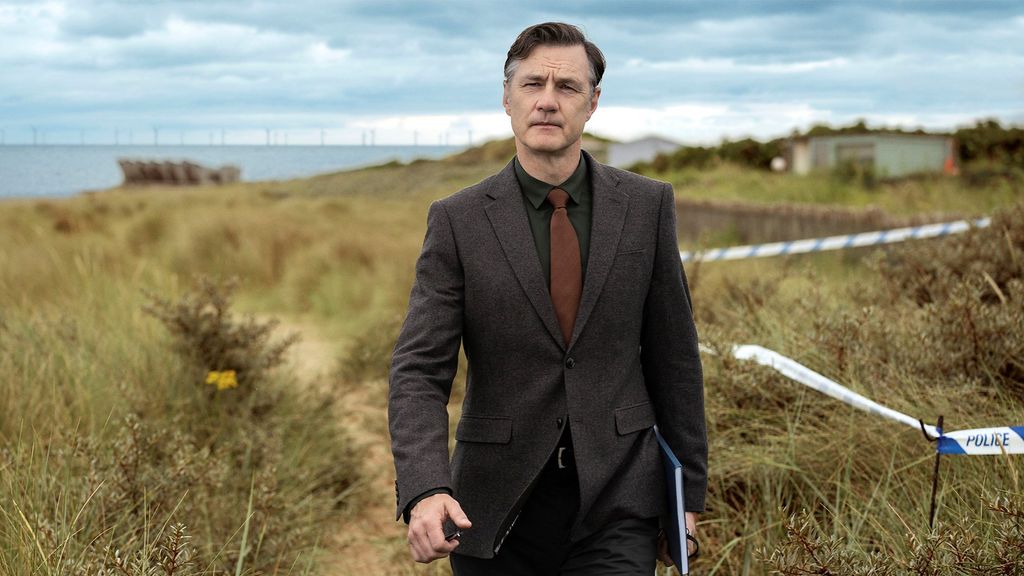
The series ignites in Episode 1, “Vanished,” with a deceptively serene dawn over Clifton College-inspired halls, where ancient oaks frame manicured lawns like silent sentinels. Sarah Polly (Emma Appleton, The Killing Kind), a poised history teacher with a laugh that echoes like wind chimes, kisses her husband goodbye before a morning jog through the adjacent woods. She’s the glue of her world: devoted wife to headmaster Michael Polly (David Morrissey, Sherwood), mentor to wide-eyed students, confidante to faculty frazzled by Ofsted inspections. Michael, 50-something and silver-fox impeccable, strides through assembly with the gravitas of a man who’s tamed teenage tempests—his sermons on integrity landing like gospel in a chapel of entitlement. But as the clock ticks past noon without Sarah’s return, the idyll fractures. Her phone buzzes unanswered in the staffroom; her running shoes sit untouched by the door. Enter Detective Sergeant Annie Cassidy (Eve Myles, Broadchurch), a Bristol lifer with a no-nonsense bob and eyes sharpened by overlooked cases. Divorced, dogged, and demoted for bucking brass, Annie’s gut screams foul play the moment she clocks Michael’s unflinching calm—no frantic calls, no red-rimmed eyes, just a measured press statement to assembled parents. “She’s probably taken a detour—Sarah’s always been impulsive,” he says, his Liverpool lilt steady as slate. But Annie senses the script: the too-perfect alibi, the faculty’s averted gazes. Kay’s opener is a slow fuse—interviews with jittery teachers revealing whispers of marital frost, a student’s doodled caricature of Michael as a puppeteer. By nightfall, as searchlights sweep the forest’s underbrush, a bloodied scarf snags on brambles. Accident? Or the first thread pulled from a tapestry of deceit? Viewers will grip their remotes, Myles’s Annie a beacon of grit in the gathering gloom, her notebook filling with questions that cut deeper than forensics.
Episode 2, “Suspect,” escalates the cat-and-mouse into a labyrinth, thrusting Annie into the viper’s nest of St. Edmund’s School—a bastion of old money where scholarships are the exception, scandals the unspoken rule. Michael’s fortress crumbles under scrutiny: alibis checked via CCTV glitches, phone pings mapping a midnight wander to the woods. Morrissey’s portrayal is a tour de force of restraint—his Michael not a snarling villain, but a sphinx whose micro-pauses betray volumes, a man who’s mastered the art of saying nothing with a smile. Flashbacks peel back the Pollys’ facade: Sarah’s growing disillusionment with the school’s “legacy of boys,” her secret affair with a bohemian artist glimpsed in hurried sketches, Michael’s simmering resentment over her “distractions” from his ascension. Annie, meanwhile, battles her own demons— a superior (Clare Higgins, Downton Abbey) dismissing her as “overzealous,” a ex-husband texting olive branches she ignores. The episode’s pivot is a faculty soiree turned interrogation: wine flows, but so do slips— a deputy head (Elliot Cowan, Foundation) hinting at embezzled endowments, a counselor (Jennifer Macbeth, Maternal) alluding to covered-up assaults. Laxton’s camera prowls like a predator, low angles distorting oak-paneled halls into cages, rain lashing windows like accusatory fingers. It’s here Gone outpaces Broadchurch’s coastal whispers: where that series simmered on community complicity, this boils with institutional rot, privilege as poison. A mid-ep cliffhanger—a student’s anonymous tip about Sarah’s “dangerous discovery”—leaves pulses racing, Annie vowing, “This place eats its own; I’m just here to watch it choke.”
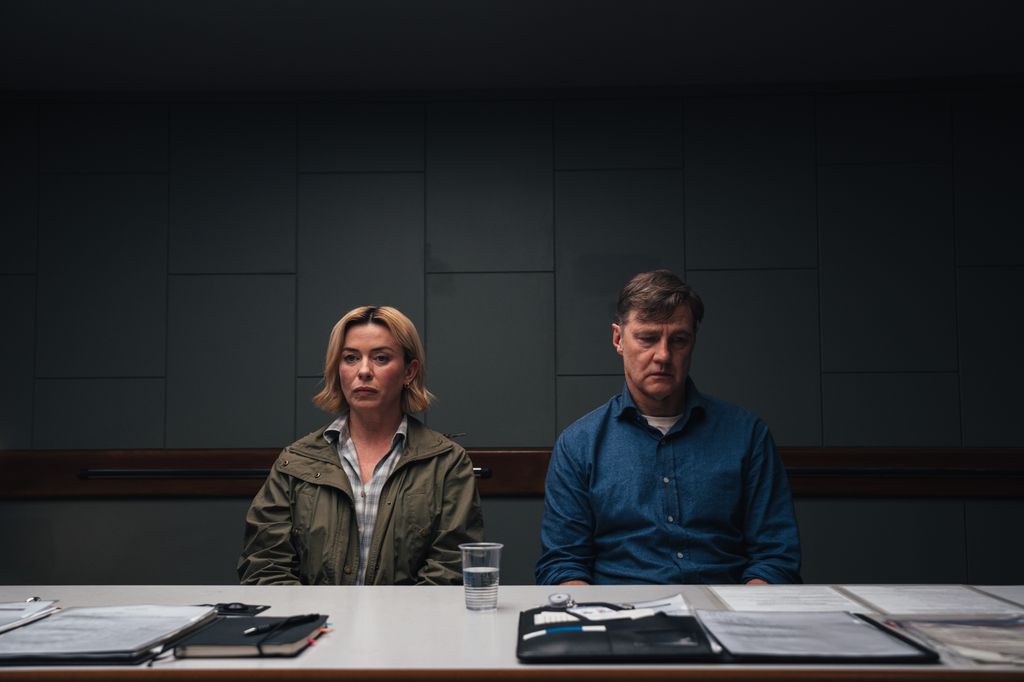
By Episode 3, “Entanglements,” the school’s underbelly erupts, scandals blooming like nightshade in the garden of Eden. Alana Polly (Emma Appleton doubling as daughter and wife? Wait, no—Appleton as Alana, the sharp-tongued English teacher and Michael’s daughter, who idolizes yet resents him), becomes Annie’s reluctant ally, her loyalty fraying over late-night confessions: “Dad’s the king here, but kings fall hard.” Revelations cascade—Michael’s past as a scholarship boy turned tyrant, bullying buried under NDAs; a ring of elite parents trading favors for grades, Sarah the whistleblower poised to expose it all. Myles shines as Annie unearths a parallel: her own overlooked trauma from a botched case mirroring Sarah’s silenced voice. Subplots thicken without tangling: Nicholas Nunn (Rogue Heroes) as a sleazy bursar with ledger leaks, Billy Barratt (The White Princess) as a troubled teen with a phone full of illicit snaps. The forest, a recurring motif, swallows another victim—a groundskeeper vanishing mid-shift—forcing Annie into a tense stakeout where Michael’s silhouette merges with the trees. Kay’s script indicts the elite’s echo chamber: “We protect our own,” a governor sneers, but protection curdles to conspiracy. Compared to The Sinner’s solitary spirals, Gone’s ensemble fractures wider, each lie a shard reflecting societal fractures—class warfare in corduroy blazers. The episode closes on a gut-wrench: Sarah’s journal, unearthed in a locked drawer, scrawling, “He’ll burn it all before he lets it break.”
Episode 4, “Fractures,” plunges into psychological quicksand, alliances shifting like fog over the Avon. Annie’s suspended after a heated clash—punching a wall, not a suspect—but goes rogue, tailing Michael to a clandestine meet in the woods. Morrissey’s depth devastates: a breakdown in the chapel, fists pounding pews, revealing not just motive but madness—a childhood theft framed as “borrowed ambition,” fueling his iron grip. Alana’s arc arcs toward betrayal, her affair with a colleague (Arthur Hughes, The Innocents) weaponized by Michael’s manipulations. Higgins’s steely superintendent adds layers, her Downton-esque poise cracking to expose complicity in past cover-ups. Laxton amplifies unease with sound design—creaking floorboards like bones, distant bells tolling regrets—turning the school into a character as alive as it is lethal. Viewer proxies will ache with Annie’s isolation, her voiceover musing, “Truth’s a ghost here; you chase it till it haunts you.” Twists proliferate: a forged email trail implicating Sarah in embezzlement, a student’s suicide note echoing her warnings. It eclipses Broadchurch’s emotional sprawl by laser-focusing on personal peril—Annie’s daughter, estranged and echoing Alana’s vulnerability, blurring lines between case and kin. The hour ends in conflagration: a midnight blaze in the archives, documents curling to ash, Michael’s shadow fleeing the flames.
Episode 5, “Confessions,” hurtles toward implosion, the school a tinderbox primed by privilege’s pyre. Annie, reinstated amid internal affairs’ scrutiny, corners witnesses: Rupert Evans (The Man in the High Castle) as a guilt-ridden chaplain spilling sacramental sins, Jodie McNee as a junior teacher trading testimony for tenure. Michael’s facade fissures—confrontations laced with paternal menace toward Alana, whose pregnancy revelation detonates family fault lines. Kay weaves prejudice’s web: Annie’s working-class roots dismissed as “bias,” Michael’s polish a shield against scrutiny. The forest claims its toll—a body dredged from a pond, not Sarah’s but a link to the school’s dark alumni. Myles’s Annie evolves from underdog to avenger, her interrogation of Michael a verbal duel that crackles: “You built this empire on bodies—how many more before it buries you?” Morrissey counters with chilling charisma, his breakdown a mosaic of victim and villain. Echoing The Sinner’s guilt-gnawed psyches but amplified by ensemble entropy, the episode indicts legacy’s lie—elite education as enclosure, trapping all within. A bombshell DNA match ties Michael to an old assault, but whose? The cliffhanger—a scream from the woods—ensures insomnia, forums flooding with theories: “This is Broadchurch on steroids—darker, dirtier, done right.”
The finale, Episode 6, “Ashes,” doesn’t tidy; it torches. Sarah’s fate crystallizes in a dawn raid: alive, hidden in a cottage by a lover fleeing extradition, her “disappearance” a desperate bid to flee Michael’s clutches. But the school? It burns—literally, as embezzlement evidence ignites parental panic, governors scattering like roaches. Michael’s empire crumbles in court: confessions cascading, his “perfect” life exposed as predatory patchwork. Annie triumphs, but scarred—reuniting with her daughter amid the rubble, a nod to trust’s tentative rebuild. Alana chooses exile, torching her father’s portrait in a symbolic send-off. Laxton’s close is operatic: flames licking the chapel spire, a requiem score swelling as survivors walk into mist. Kay’s denouement probes deeper than resolution—privilege’s privilege to evade, prejudice’s blind eye—leaving Gone not as solved puzzle, but festering wound. Outclassing Broadchurch’s communal catharsis with institutional indictment, The Sinner’s introspection with societal scope, it’s a prestige pinnacle: dark, twisted, uncomfortably personal.
Gone’s alchemy? Kay’s forensic flair, honed on Hijack’s hijackings, crafts a procedural that’s profoundly human—no gadgetry, just gut and guile. Laxton’s visuals—Bristol’s bridges as metaphors for broken bonds, the forest a Freudian thicket—elevate every frame. The cast? A constellation: Myles’s fierce fragility, Morrissey’s magnetic menace, Appleton’s poised peril, Higgins’s haughty hubris. Inspired by To Hunt a Killer’s real hunts, consultants Julie Mackay and Robert Murphy infuse authenticity—interrogations ring true, cover-ups reek of boardroom. At 2026’s dawn, amid Line of Duty droughts, Gone reignites the flame: a thriller that doesn’t just grip—it guts, forcing reckoning with the secrets we school ourselves to ignore. ITV’s struck gold again; stream it, then stare at your own shadows. The headmaster’s watching.