How Avengers: The Kang Dynasty Was Originally Planned: A Much Darker, Wilder Multiversal Epic That Never Happened
The Marvel Cinematic Universe nearly delivered one of its most ambitious and chaotic chapters with Avengers: The Kang Dynasty. Before Jonathan Majors’ departure and the studio’s pivot to Robert Downey Jr. as Doctor Doom in Avengers: Doomsday, the film was shaping up to be a sprawling multiversal epic. It would have unified elements from decades of Marvel storytelling, elevated Kang the Conqueror as the architect of a new world order, and given iconic legacy characters pivotal, often tragic roles. Far from the current trajectory, this version promised a darker, more interconnected narrative centered on the collapse of reality itself.
At its core, the scrapped project aimed to bridge the gap between the original 2000s Spider-Man films, the X-Men universe, and the main MCU timeline. Kang wasn’t just another villain—he was positioned as the force responsible for creating Battleworld, a patchwork planet forged from shattered realities. Doctor Doom, notably, was not yet envisioned as the central antagonist in these early plans, leaving Kang (and cosmic entities tied to him) to drive the conflict. The story would have explored themes of legacy, sacrifice, and the fragile nature of heroism across timelines.
The Setup: Anchor Beings and the Council of Kangs
The plot reportedly began with the Time Variance Authority (TVA) identifying “Anchor Beings”—key individuals whose existence stabilized entire realities. If these anchors were removed or killed, their timelines would unravel. This concept pulled directly from multiversal events like Spider-Man: No Way Home and Loki, expanding them into a full-scale crisis.
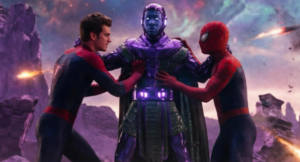
Tobey Maguire’s Spider-Man and Andrew Garfield’s Spider-Man were cast as anchors for their respective universes, serving as wise, battle-hardened leaders of a resistance against the growing Kang threat. Meanwhile, Tom Holland’s Peter Parker, as the anchor for Earth-616 (the main MCU timeline), would face an even heavier burden. His journey was set to culminate in him becoming a central figure on Battleworld—potentially the strongest Avenger in that new realm—shifting him from a friendly neighborhood hero to a leader navigating moral gray areas in a fractured world.
The primary antagonists were the Council of Kangs, a multiversal assembly of variants working in concert to dominate all timelines. A mega-powerful version of Kang would emerge victorious by absorbing the powers of the Beyonder (or a Beyonder-like entity), transforming into a god-like being with near-omnipotent control over time, space, and reality. This “Beyonder Kang” would weaponize the chaos of collapsing universes rather than prevent it.
Spider-Men at the Forefront
One of the most exciting aspects was the Spider-Man focus. Tobey Maguire’s seasoned Peter Parker and Andrew Garfield’s more tormented version were envisioned leading the charge in a multiversal resistance. Their experience with loss, alternate realities, and personal sacrifice would make them natural mentors and warriors against the Kangs.
Tom Holland’s Spider-Man, by contrast, starts as a key defender of Earth-616 but evolves dramatically. In the new Battleworld landscape—formed from merged timelines—his Peter becomes a battlefield leader, perhaps even ruling or heavily influencing a faction. This setup would have explored the “strongest Avenger” idea in a fresh way, emphasizing strategy, resilience, and the weight of responsibility over raw power. Miles Morales was also rumored to debut or play a supporting role, adding another layer to the web-slinging legacy.
The three Spider-Men uniting (and occasionally clashing) would have been a dream for fans, paying homage to the Raimi and Webb eras while integrating them into the MCU’s fabric.
Loki’s Crucial Role and Wolverine’s Farewell
Loki, fresh from his time-traveling exploits and TVA adventures, was positioned as a key piece in defeating Kang. His mastery of deception, time manipulation, and god-level trickery made him essential for outsmarting the Conqueror variants. Whether through alliances, sacrifices, or clever schemes, the God of Mischief’s arc would have tied directly into the multiversal war, potentially involving variants or echoes of his past selves.
Hugh Jackman’s Wolverine was slated for an emotional farewell. As another anchor being, Logan’s story would culminate in a selfless sacrifice to save not just his team, but all heroes across realities. This would serve as a poignant send-off for the character who defined the mutant genre for decades, echoing the themes of Logan while giving Jackman a heroic, universe-spanning exit. His death (or apparent death) would ripple across the story, motivating others and highlighting the high stakes of the multiversal collapse.
Other legacy elements, like Nicolas Cage’s Ghost Rider, were reportedly in the mix as additional anchors or powerful allies, adding even more fan-service flair to the ensemble.
The Fall of the Multiverse and Birth of Battleworld
Unlike typical Avengers films where heroes ultimately triumph, The Kang Dynasty was designed to end in failure. The combined efforts of multiple Avengers teams, the Spider-Men resistance, and other anchors would fall short against the Council and the empowered Beyonder Kang. This defeat triggers the total collapse of the multiverse, with realities crumbling and timelines merging violently.
From the wreckage, Kang creates Battleworld—a single, patchwork domain where fragments of different universes coexist. This new world becomes the stage for the next phase of the saga (originally leading into Secret Wars). Survivors, including the Spider-Men and remaining Avengers, would find themselves in a brutal new reality where old rules no longer apply. Tom Holland’s Peter, elevated as a leader on this battlefield, would stand as one of the most powerful figures amid the chaos.
The tone was reportedly darker and more consequential than what we’ve seen in recent MCU entries. It emphasized the cost of heroism, the inevitability of change, and the idea that even Earth’s Mightiest Heroes couldn’t prevent catastrophe. Kang’s victory (however temporary) would have solidified him as a Thanos-level threat, but with a more personal, timeline-shattering twist.
Why It Changed and Its Lasting Impact
The shift away from this vision came amid real-world challenges, including casting issues and creative reevaluations. The studio ultimately pivoted to Doctor Doom as the unifying force for the Multiverse Saga’s climax. While Avengers: Doomsday and the upcoming Secret Wars will still deliver massive crossovers and high stakes, they diverge significantly from the Kang-centric, Battleworld-origin story that was once in development.
This original Kang Dynasty plan represented peak multiversal ambition. It would have celebrated Marvel’s cinematic history by weaving in Tobey and Andrew’s Spider-Men, Hugh Jackman’s Wolverine, and other fan favorites into one cohesive (if destructive) narrative. The unification of 2000s-era stories with the modern MCU, the creation of Battleworld under Kang, and the emotional goodbyes would have made it a true turning point.
Fans can only imagine the spectacle: epic Spider-Man team-ups, Loki’s cunning saving the day (or trying to), Wolverine’s tear-jerking sacrifice, and the birth of a new Battleworld order with Tom Holland’s Spider-Man at its helm. It was going to be a very different movie—one that embraced failure as a path to something bigger, setting the stage for even grander conflicts ahead.
Though it never came to fruition, these rumored plans continue to excite discussions about what the MCU could have been. They remind us of the infinite possibilities within the multiverse—and how one major pivot can rewrite an entire saga. In the end, the road not taken sounds like it would have been an unforgettable ride.