“He Seemed to Be Searching for Something” – Psychologist Re-Analyzes Noah Donohoe’s Final CCTV Movements Before Disappearance
The inquest into the death of 14-year-old Belfast schoolboy Noah Donohoe has entered a deeply unsettling phase as new expert testimony re-examines the last known CCTV footage of him alive. A forensic psychologist reviewing the Northwood Road clips has concluded that Noah’s behaviour strongly suggests he was “searching for something” or “someone” in the moments before he abandoned his bicycle and ran into an alleyway. The observation has intensified questions about what drove Noah to behave so erratically on the evening of Sunday 21 June 2020, and why his final movements still contain so many unanswered gaps.
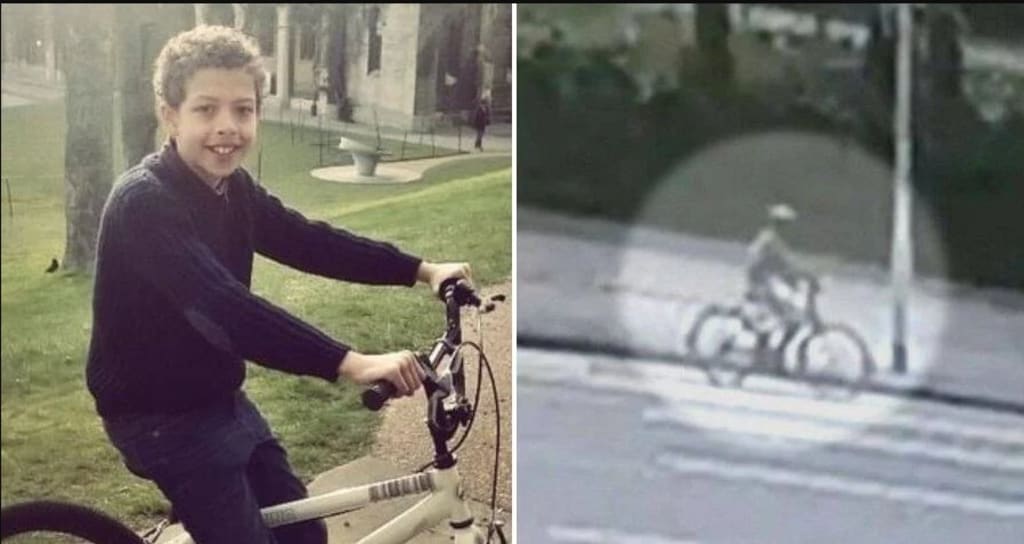
Noah left his home in the Holylands area of south Belfast around 5:41 p.m. on his bicycle. He was captured on city-centre CCTV at approximately 5:53 p.m. near the Art College at the junction of York Street and Frederick Street, still fully clothed and carrying his backpack. That was the last time he appeared normal. Roughly 20–30 minutes later, in the Northwood Road area of north Belfast (about 3 miles from home), multiple cameras recorded a radically different scene: Noah cycling completely naked, slowing down, dropping his bike, and then sprinting barefoot toward a narrow alley between two houses. He never re-emerged from that alley on any available footage.
The psychologist, giving evidence at Belfast Coroner’s Court in early March 2026, described Noah’s actions in those final clips as purposeful rather than purely random or panicked. The boy pauses, looks around, moves his head in scanning motions, and appears to be visually searching the environment—first while still on the bike, then on foot after dismounting. The expert noted that this pattern is consistent with someone who believes they are close to a specific location, object, or person they are trying to find. The behaviour does not align with someone simply fleeing in blind terror or acting under sudden impulse; instead, it suggests intent, even if the intent itself was driven by confusion, distress, or delusion.
This interpretation directly challenges earlier police statements that Noah’s actions showed no sign of meeting or expecting to meet anyone. For years, the official line has been that no third party was involved after he left home. Yet the psychologist’s analysis raises the possibility that Noah believed he was heading toward a rendezvous, a drop-off point, or a place he associated with someone specific. The fact that he removed all his clothing before entering the alley—leaving every item of apparel behind—further complicates the picture. The expert suggested this could indicate a dissociative state, extreme panic, or an attempt to “reset” or escape from overwhelming internal sensations, but the deliberate searching movements do not fit neatly into pure flight.
The inquest has already heard that Noah exhibited unusual and distressed behaviour at home in the hours before he left. His mother, Fiona Donohoe, reported that he was agitated, moody, and inconsistent. He lied about his destination (telling her he was going to Cavehill with friends, though friends later said no such plan existed). He took his laptop and backpack but abandoned both along the route. Phone data later showed messages suggesting he may have arranged to meet someone around 6 p.m., though the content and recipient(s) remain under examination.
The Northwood Road CCTV remains the last visual record of Noah alive. After running into the alley, he is not seen again on any camera. His bicycle was recovered nearby, along with his clothes, backpack, and other belongings scattered in the vicinity. Six days later, on 27 June 2020, his body was found deep inside a storm drain (culvert) system roughly 625 metres downstream from the inlet nearest to Northwood Road. The coroner’s pathologist confirmed drowning as the cause of death, with no alcohol, drugs, or signs of external trauma.
The storm drain itself has been one of the most controversial aspects of the case. The inlet cover was described as “unlocked and easily opened,” with a gap in the steel bars wide enough for a 14-year-old boy to squeeze through. Inside the culvert, conditions were described as “complete darkness,” cold, wet, and filled with debris. Search teams entered sections of the system but found no trace of Noah until his body was discovered on the sixth day. A former police search adviser testified that the culvert was considered a “very low probability” site—estimated at around 5%—and was checked primarily to rule it out completely.
The psychologist’s re-analysis of the footage has reignited debate about whether Noah entered the drain voluntarily or under some form of compulsion—psychological, environmental, or otherwise. The searching movements could indicate he believed something (or someone) he needed was in that direction. Alternatively, they might reflect a dissociative or delusional state in which he perceived a threat or objective that did not exist in reality. Without toxicology showing substances and without clear evidence of third-party involvement, the exact trigger remains elusive.
Noah’s mother, Fiona Donohoe, has attended nearly every hearing. She has consistently maintained that her son was vulnerable and that his behaviour in the days leading up to his disappearance should have prompted different investigative priorities. The family’s legal team has repeatedly challenged police accounts of the early response, including delays in acting on phone pings, incomplete CCTV trawls, and the initial hypothesis that Noah might have gone missing voluntarily.
The inquest, now in its later stages under Coroner Mr Justice Rooney, continues to hear from forensic experts, engineers, pathologists, and additional witnesses. The jury has been reminded to focus solely on evidence presented in court and to disregard speculation that has circulated online since 2020. Yet with each new piece of testimony—particularly the psychologist’s careful dissection of the final CCTV—the case grows more complex and more heartbreaking.
Noah Donohoe was remembered by teachers and friends as a bright, kind, creative boy who loved music, reading, and spending time with family. His death at 14 left an enduring wound on his school (St Malachy’s College), his community, and his family. The inquest seeks to establish not just the medical cause of death, but the full circumstances that led a healthy, loved teenager to enter a pitch-black storm drain on a summer evening in 2020.
As the hearings continue, the image of Noah pausing, scanning, and moving purposefully toward that alley remains one of the most haunting elements. Whether he was searching for something real or something only he could perceive, the truth about those final minutes is still slowly unfolding—one piece of evidence at a time.