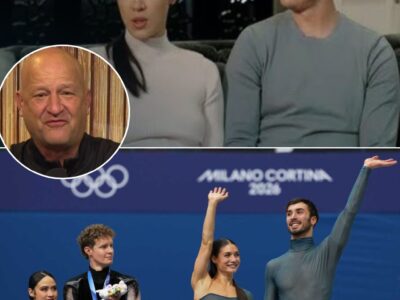
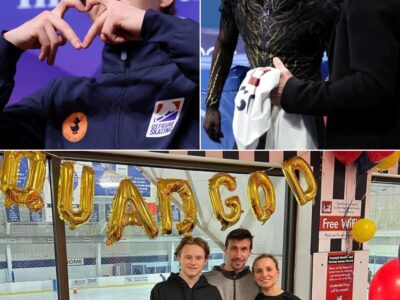
The ice in Milano Cortina still echoed with the shock of what had just unfolded. Ilia Malinin, the 21-year-old American phenom dubbed the “Quad God,” the first man to land a quadruple Axel in competition, the two-time world champion who had gone unbeaten in 14 straight international events, had faltered spectacularly in the men’s singles free skate at the 2026 Winter Olympics. He fell twice, popped jumps, struggled with elements that had once seemed automatic, and finished a stunning eighth place overall—off the podium entirely. Kazakhstan’s Mikhail Shaidorov claimed the unexpected gold, with Japan’s Yuma Kagiyama and Shun Sato taking silver and bronze.
The arena lights felt harsher in that moment, the crowd’s gasp still hanging in the air. Malinin, usually unflappable with his easy smile and preternatural calm, sat in the kiss-and-cry area, head bowed, eyes red-rimmed, processing a reality no one had foreseen. He later told reporters it felt like the weight of the world had flooded in—negative thoughts, traumatic memories, overwhelming pressure that made his body betray him on the ice. “I blew it,” he said simply on the broadcast, voice cracking. “I can’t process what just happened.”
But the deeper story emerged not from the arena, but from the quiet, raw words of the woman who knew him best: his mother, Tatiana Malinina. A former Olympic skater herself—who competed for Uzbekistan at Nagano in 1998 and Salt Lake City in 2002—Malinina had been one of Ilia’s primary coaches alongside his father, Roman Skorniakov. Yet she wasn’t in the stands that night. She rarely was. The pressure was too much for her; she preferred to wait for her husband’s call after the event, then watch the footage days later when the raw emotion had dulled.
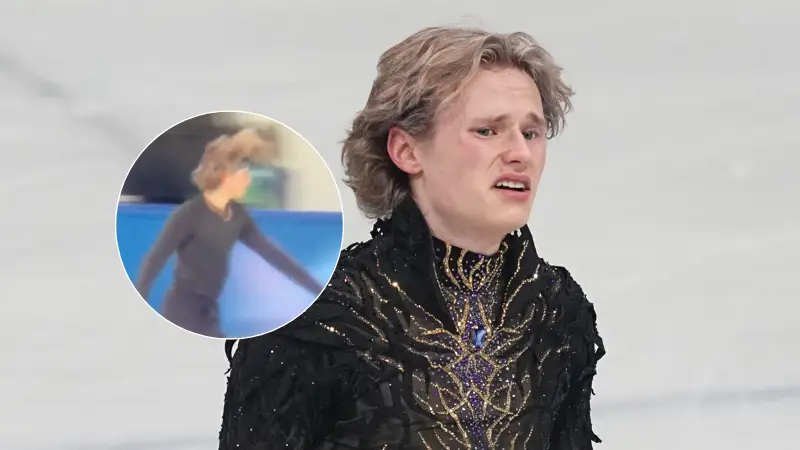
When the disappointing result hit, Malinina spoke out in an emotional statement that cut through the noise of scores and standings. Fighting back tears, she laid bare the invisible cost of her son’s pursuit of greatness. “My son sacrificed his youth, his dreams, and his peace of mind for our family—and for the U.S.,” she said, voice trembling. She described the endless late-night training sessions, the physical toll that left him exhausted yet pushing onward, the harsh online criticism and public scrutiny he absorbed without complaint. At just 21, Ilia wasn’t only battling technical difficulty and elite competition; he carried the expectations of an entire nation that had crowned him the heir to American figure skating dominance.
The public, she pointed out, saw the dazzling quads, the record-breaking programs, the effortless charisma. They didn’t see the quiet breakdowns behind closed doors, the mental strain of being the favorite, the loneliness of shouldering a legacy while still so young. Her words shifted the narrative overnight—from disappointment over a missed medal to a broader conversation about the human price of elite sport. Fans flooded social media with support, sharing stories of their own pressures, acknowledging that even the strongest athletes fight battles no one sees.
Malinin himself broke his silence a few days later in a poignant Instagram post. He shared a video montage: triumphant moments juxtaposed with a stark black-and-white image of himself head in hands, caption hinting at an “inevitable crash” under endless pressure and “vile online hatred.” He wrote of invisible battles, how fear and noise can taint even the happiest memories, how the mind buckles under insurmountable expectations. “On the world’s biggest stage, those who appear the strongest may still be fighting invisible battles on the inside,” he reflected. He admitted the Olympic environment had overwhelmed him in ways he hadn’t anticipated—nerves that made everything feel out of control, thoughts that flooded in during his starting pose. Yet he ended on a note of resilience: he wasn’t giving up.
The performance itself had started with promise. In the short program earlier, Malinin held the lead. He opened the free skate confidently, landing a strong quad flip. But the attempted quad Axel—his signature, the jump no other man had mastered in competition—turned into a bailout. Momentum slipped away. Falls followed on other elements, jumps popped or under-rotated. His score plummeted to 156.33 for the free skate, totaling 264.49—far below his personal best. He hugged Shaidorov afterward, congratulating the new champion with genuine grace, a display of sportsmanship that endeared him further to fans.
Malinin had already contributed to Team USA’s gold in the figure skating team event days earlier, where he delivered a strong free program to help secure the win. That triumph felt distant now. He later reflected that if he’d had the experience of the 2022 Beijing Olympics—where he wasn’t selected—he might have handled the pressure better. “It’s not easy,” he said on a hot mic in the kiss-and-cry, a moment that captured his raw vulnerability.
Tatiana’s confession resonated because it humanized the sport. Figure skating demands perfection under glaring lights, yet athletes are not machines. The late nights in the rink, the sacrifices of normal teenage years, the mental load of constant judgment—Malinin had borne it all with quiet determination. His parents, both Olympians, understood that world intimately. They had raised him on the ice, coached him through every milestone: the historic quad Axel in 2022, back-to-back world titles, an unmatched streak. But even they couldn’t shield him from the unique burden of being the favorite at his first individual Olympics.
In the days that followed, the skating community rallied. Fellow athletes spoke of shared struggles; fans sent messages of unwavering support. Malinin’s post-Olympic reflection hinted at growth ahead—he planned to compete at worlds in Prague the following month, chasing a third straight title. The “crash” had come, but it wasn’t the end of the story. It was a chapter in one of resilience.
What lingered most was the reminder Malinina offered: greatness isn’t just about medals. It’s about the unseen sacrifices, the quiet endurance, the family standing behind every jump. Ilia Malinin may not have claimed individual gold in Milano Cortina, but in exposing the toll of his journey—and in his mother’s brave words—he sparked something deeper. A recognition that behind every legend is a human story, one of pain, pressure, and unyielding heart. And in that, perhaps, he achieved something more lasting than any score could measure.