FORGOT ‘ONLY MURDERS IN THE BUILDING’? Kristen Bell’s Twisted Netflix Crime Thriller Secretly Turns the Entire Murder-Mystery Genre Upside Down — A Darkly Funny, Satirical Whodunit So Addictive Viewers Are Finishing All 8 Episodes in One Night!!
In a streaming landscape overflowing with glossy murder mysteries and psychological thrillers, Netflix delivered a deliciously self-aware gem that stands apart by brilliantly mocking the very conventions it embraces. The Woman in the House Across the Street from the Girl in the Window (yes, the title is deliberately exhausting) is an eight-episode limited series that premiered in January 2022, starring Kristen Bell in a tour-de-force performance that blends vulnerability, deadpan humor, and escalating absurdity. What starts as a familiar tale of a troubled woman who may or may not have witnessed a murder evolves into a sharp, chaotic satire that skewers the tropes of unreliable narrators, wine-soaked sleuthing, and increasingly ludicrous plot twists. Viewers craving something cleverer than standard binge fare have embraced it as a wildly entertaining deconstruction of the genre.
Created by Rachel Ramras, Hugh Davidson, and Larry Dorf, the series is a loving yet merciless parody of books and films like The Girl on the Train, The Woman in the Window, and similar domestic suspense stories. It pokes fun at their repetitive formulas—grieving protagonists, heavy drinking, rain-induced trauma, suspicious neighbors, and unreliable memories—while still delivering a surprisingly compelling mystery wrapped in layers of dark comedy. Bell, who also executive produced, throws herself into the role with impeccable timing, making Anna both sympathetic and hilariously unhinged.
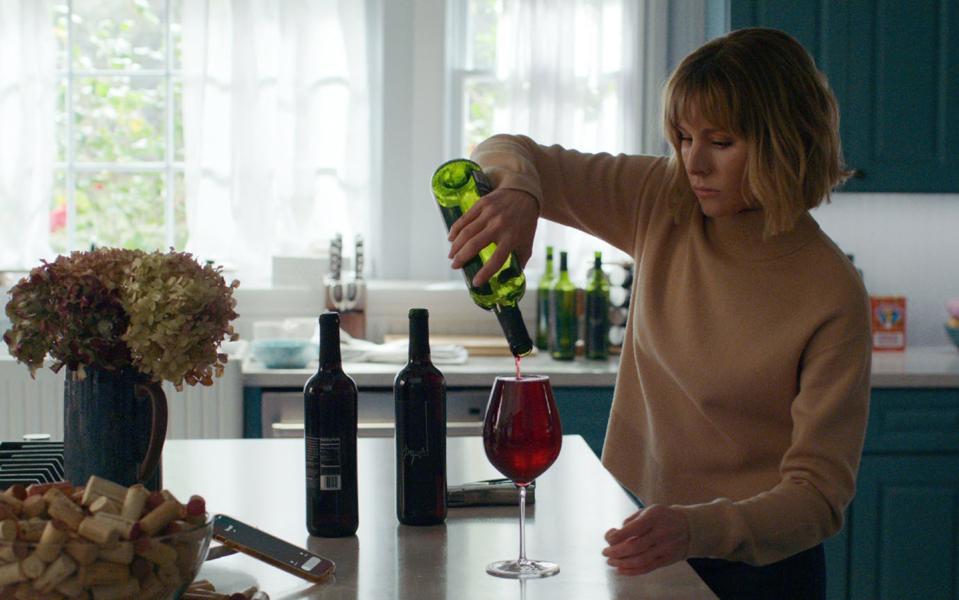
At the center is Anna (Kristen Bell), a once-accomplished painter whose life has unraveled following a devastating personal tragedy. Plagued by ombrophobia—a paralyzing fear of rain tied to her daughter’s horrific death—she spends her days in a fog of oversized glasses of red wine, prescription pills, and chicken casseroles (her one reliable culinary output). From her comfortable suburban home, she watches the world pass by through her front window, disconnected from reality and haunted by grief, hallucinations, and voices in the attic. Her marriage to a forensic psychologist has crumbled, leaving her isolated and adrift.
Things shift when a handsome new neighbor, Neil (Tom Riley), moves in across the street with his charming young daughter Emma (Samsara Yett). Neil, a seemingly perfect widower, sparks a flicker of hope and attraction in Anna. For the first time in ages, she ventures out, attempts to reconnect with her art, and even entertains romantic possibilities. That optimism shatters one stormy night when Anna witnesses what appears to be Neil’s girlfriend Lisa (Shelley Hennig) being brutally murdered—throat slit at the window in a gruesome scene. Or did she? The next day, Lisa is nowhere to be found, Neil claims she simply left for Seattle, and no one believes Anna’s account.
What follows is a whirlwind of amateur detective work fueled by Anna’s determination, impaired judgment, and overactive imagination. She snoops around the crime scene (or lack thereof), interrogates neighbors, and pieces together clues amid blackouts and paranoia. The supporting cast is filled with eccentric characters who heighten the absurdity: Mary Holland as the overly enthusiastic Sloane, Cameron Britton as the enigmatic Buell, Michael Ealy in a key role, and a host of red herrings that keep viewers guessing. Every neighbor, delivery person, and passing stranger becomes a potential suspect, turning the quiet street into a minefield of secrets and odd behaviors.
The series excels at balancing genuine suspense with laugh-out-loud satire. Classic thriller elements are amplified to ridiculous degrees: Anna’s endless wine consumption leads to comically timed blackouts; her fear of rain triggers dramatic meltdowns; and the plot piles on twists involving ventriloquist dummies, family secrets, serial killers, and increasingly outlandish revelations. One standout absurdity involves the gruesome details of her daughter’s death, which exemplifies the show’s willingness to go gloriously over-the-top. Yet beneath the humor lies a surprisingly poignant exploration of grief, isolation, and the search for purpose after loss.
Directed primarily by Michael Lehmann (known for Heathers), the show maintains a stylish visual tone that mimics the moody aesthetics of the genres it mocks—cinematic rain-soaked windows, shadowy interiors, and tense voyeuristic shots—while undercutting them with witty dialogue and physical comedy. Bell’s performance anchors everything; she plays Anna with straight-faced sincerity, making the character’s spiraling antics both heartbreaking and hilarious. Her chemistry with Riley adds romantic tension, while interactions with the precocious Emma tug at the heartstrings.
As the episodes progress, the mystery deepens with shocking revelations that question reality, memory, and motive. Suspects multiply, alliances shift, and the line between Anna’s perceptions and actual events blurs masterfully. The finale delivers a payoff that feels both satisfying as a whodunit and uproariously fitting as satire, tying up loose ends in a way that cleverly comments on the genre’s penchant for wild explanations. Many viewers report devouring all eight episodes in a single sitting, drawn in by the addictive “just one more” structure and the escalating chaos.
Critically, the series received mixed but often appreciative reviews. Some praised its sharp wit and Bell’s commitment, hailing it as a refreshing, self-referential take that revitalizes familiar tropes through humor. Others found the pacing uneven or the parody too broad at times. Audiences, however, largely embraced its bingeability, with many highlighting how it rewards familiarity with the parodied works while remaining accessible. Its ability to be both funny and tense makes it ideal for fans of dark comedies like Dead to Me or quirky mysteries.
Beyond the laughs, The Woman in the House offers subtle social commentary on suburban ennui, the pressures on women in crisis narratives, and society’s fascination with true-crime voyeurism. It lampoons the “troubled woman solves crime” archetype while giving its protagonist real agency and emotional depth. Anna’s journey from passive observer to active (if flawed) investigator resonates as a story of reclaiming one’s life amid tragedy.
In an era where murder-mystery series often take themselves too seriously, this Netflix gem stands out for its bold willingness to laugh at the formula. Kristen Bell’s magnetic presence, combined with clever writing and escalating absurdity, creates a uniquely addictive experience. Whether you’re a die-hard fan of psychological thrillers or simply in the mood for something clever and chaotic, this series delivers suspense, heart, and plenty of wine-fueled hilarity.
Forget the straightforward procedurals—The Woman in the House Across the Street from the Girl in the Window flips the genre on its head and invites you to enjoy the ridiculous ride. Pour a (normal-sized) glass, settle in by the window, and prepare for a binge that might just restore your faith in satirical storytelling. It’s proof that sometimes the best way to appreciate a genre is to mercilessly roast it.