A new drama starring Joel Edgerton and Felicity Jones has quietly landed on Netflix, with critics calling it one of the best films of the year and early viewers praising its emotional intensity, cinematic quality, and powerful storytelling.
But what happens in the final moments of the film… is what’s now making this explode.
Train Dreams, the quietly devastating adaptation of Denis Johnson’s beloved novella, has emerged as one of Netflix’s most acclaimed original films of 2025. Directed by Clint Bentley and co-written with Greg Kwedar (the team behind the Oscar-nominated Sing Sing), this 104-minute period drama unfolds as an intimate epic — a meditative portrait of one ordinary man’s life against the sweeping backdrop of America’s rapid transformation in the early 20th century. Far from a conventional Hollywood narrative, the film rejects spectacle in favor of quiet grace, profound loss, and the haunting beauty of existence itself. Viewers expecting another flashy streaming release have instead found themselves deeply moved, often speechless, by its poetic restraint and emotional resonance.
Set primarily in the rugged Idaho panhandle and the vast Pacific Northwest during the 1910s and 1920s, Train Dreams follows Robert Grainier, a logger and railroad laborer whose existence spans an era of monumental change. The story chronicles his days building bridges and clearing forests for the expanding railroads, his tender courtship and marriage, the birth of his daughter, and the profound tragedies that reshape his world. As America hurtles toward modernity — with trains symbolizing both progress and destruction — Robert’s life becomes a microcosm of human fragility amid nature’s indifference and industrial ambition. The film captures the majesty of untouched wilderness alongside the degradation wrought by man’s relentless expansion, all while centering on deeply personal themes of love, grief, isolation, and quiet resilience.
The narrative unfolds in a deliberately unhurried, almost dreamlike rhythm. There are no grand plot twists or high-stakes chases; instead, the story moves through vignettes that span decades, blending Robert’s daily labors with moments of unexpected beauty and crushing sorrow. Bentley’s direction emphasizes atmosphere over exposition, allowing the audience to feel the weight of time passing — the creak of timber, the roar of rivers, the distant whistle of trains cutting through pristine landscapes. Cinematography plays a starring role here, rendering every frame like a living painting: golden-hour light filtering through dense forests, snow-blanketed mountains, and the raw, muddy chaos of work camps. The score is understated yet evocative, enhancing the film’s poetic quality without ever overpowering the silence that often speaks loudest.
At the heart of Train Dreams is Joel Edgerton’s masterful performance as Robert Grainier. Edgerton delivers what many are calling one of the finest turns of his career — a layered, internalized portrayal of a man who expresses more through weathered glances, calloused hands, and stoic endurance than through dialogue. Robert begins as a rugged, somewhat solitary laborer in his early thirties, drawn to the physical demands of frontier work. Edgerton captures his quiet charm and inner reserve with remarkable subtlety, making the character feel authentically rooted in his time and place. As the years unfold, we witness Robert’s transformation: the joy of unexpected love, the pride of building a simple home, the devastation of irreplaceable loss, and the slow acceptance of solitude in old age. Edgerton’s physicality — the way he carries his body through decades of hard labor — combined with his emotional restraint creates a performance of profound depth. He doesn’t dramatize grief; he embodies it, allowing viewers to feel the accumulation of a lifetime in small, devastating details. It is a role that demands patience from both actor and audience, and Edgerton rises to it with grace and authenticity.
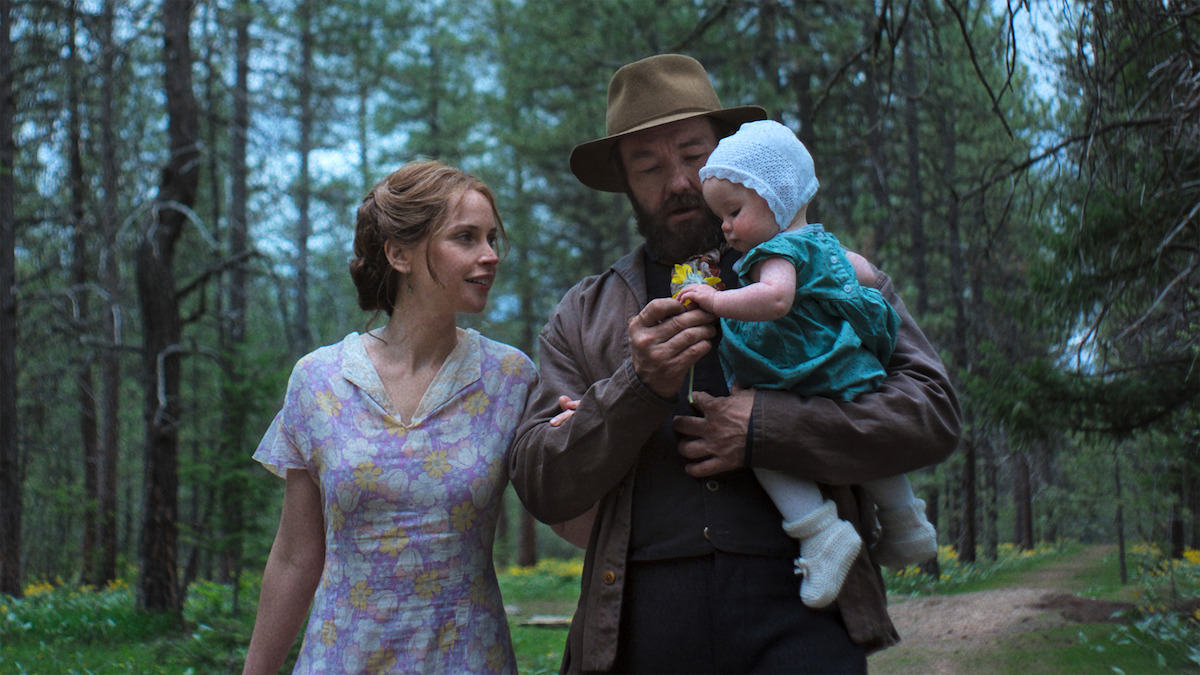
Felicity Jones brings warmth, vitality, and heartbreaking humanity to Gladys Grainier, Robert’s wife. Jones portrays Gladys as an unabashed, straightforward woman whose straightforward proposal to Robert at church sparks their tender courtship. She infuses the character with quiet strength and delight in life’s simple pleasures, making the couple’s bond feel genuine and lived-in. Their scenes together radiate a rare, unforced chemistry — moments of domestic intimacy, shared laughter, and unspoken understanding that ground the film’s larger themes. Gladys represents light and connection in Robert’s otherwise rugged existence, and Jones’ performance makes her absence in later sections of the story all the more poignant. Her screen time may be more limited than Edgerton’s, yet it leaves an indelible emotional imprint, elevating the film’s exploration of love as both anchor and vulnerability.
The supporting cast adds rich texture without ever overshadowing the central couple. Kerry Condon appears as Claire Thompson, a forestry services worker whose interactions with Robert offer glimpses of changing social dynamics and quiet companionship in later years. William H. Macy delivers a memorable turn as Arn Peeples, bringing his signature blend of folksy wisdom and understated presence to a key figure in Robert’s world. Clifton Collins Jr., Paul Schneider, Nathaniel Arcand, and John Diehl round out the ensemble with authentic portrayals of fellow laborers, neighbors, and townsfolk, each contributing to the film’s vivid sense of community and isolation. Will Patton provides narration that frames the story with a reflective, almost mythic tone, enhancing the novella’s literary roots without feeling intrusive.
The character arcs in Train Dreams are deliberately restrained yet profoundly moving. Robert’s journey is not one of dramatic redemption or heroic triumph but of quiet evolution — from a man defined by physical labor to one who confronts the limits of control in the face of love and loss. His relationship with Gladys forms the emotional core, showcasing how partnership can infuse an ordinary life with extraordinary meaning, only for fate to test that bond mercilessly. The film explores survivor’s solitude, the passage of time, and humanity’s small place within nature’s vast indifference. Secondary characters serve as mirrors to Robert’s experiences, highlighting themes of progress versus preservation, community versus isolation, and the enduring human need for connection amid change. There are no villains here — only the relentless forward march of history and the personal costs it exacts.
What has left audiences particularly stunned — and sparked intense online discussion — is the film’s final moments. Without veering into spoilers, the conclusion lands with a haunting, poetic power that crystallizes the entire narrative. It offers neither easy catharsis nor neat resolution, but rather a profound, almost spiritual acceptance of life’s impermanence. The ending elevates Train Dreams from a beautifully crafted character study into something mythic and universal, prompting viewers to sit in silence long after the credits roll, reflecting on their own fleeting dreams and losses. This quiet devastation is what transforms the film from “another Netflix drop” into a genuine cinematic event.
Visually and technically, Train Dreams is impeccable. The production design immerses viewers in the tactile reality of early 20th-century frontier life — from rain-soaked logging camps to the simple wooden cabin Robert builds with his own hands. Sound design amplifies the natural world: the thunder of falling trees, the rush of rivers, and the mechanical growl of trains cutting through wilderness. Director Clint Bentley balances epic scope with intimate delicacy, creating a film that feels both grand and deeply personal.
In the end, Train Dreams stands as a rare achievement — a meditative drama that finds epic resonance in the everyday. It reminds us that ordinary lives, marked by love, labor, and loss, can contain the wondrous and devastating layers of an entire era. Joel Edgerton and Felicity Jones anchor the story with performances of uncommon sensitivity, while the supporting ensemble and technical mastery create a fully realized world. For those seeking substance over spectacle, emotional truth over formula, this film delivers in spades.
Everyone may have expected just another streaming title, but Train Dreams has quietly become one of the year’s most powerful cinematic experiences. Its final moments don’t just conclude a story — they echo long afterward, leaving viewers stunned, moved, and grateful for the quiet grace of a life fully felt. This is the kind of film that lingers, rewards rewatches, and reaffirms why thoughtful, character-driven dramas still matter in the age of endless content. Don’t let it pass you by.
News

EXTRACTION 3 Officially in Production: Chris Hemsworth Returns as Tyler Rake, Idris Elba Reprises His Role in Netflix’s Most Explosive Action Sequel Yet
EXTRACTION 3 is officially charging into production on Netflix, with Chris Hemsworth locked in to return as the battle-hardened mercenary Tyler Rake after closing a major new deal. Idris Elba…

Dracula faces a powerful rival as darkness engulfs Europe—sparking a brutal war where immortality becomes both a weapon and a curse.
More than a decade after Dracula Untold introduced audiences to a fresh, ferocious origin for the world’s most iconic vampire, the legend roars back in Dracula 2: Reign of Shadows….

Peter Parker’s Brand New Day Brings Classic Struggles Back to the MCU — Two Jobs, Eviction Threats, and the Daily Grind of Being Spider-Man
Four years after the events of Spider-Man: No Way Home, Tom Holland’s Peter Parker wakes up to a harsh new reality. The world no longer remembers who he is. Aunt…

Shailene Woodley was cast as Mary Jane in The Amazing Spider-Man 2. She filmed four scenes with Andrew Garfield. Every single one was cut before release.
Director Marc Webb made the decision to remove all of her footage during the editing process. He felt that introducing MJ as a potential new love interest while Peter Parker…

THIS ISN’T JUST SCI-FI — IT’S A NIGHTMARE YOU CAN’T ESCAPE. Viewers called it “mind-blowing”… now it’s coming back, and this time, the story goes even deeper into the unknown. Mark your calendar — because once it starts, there’s no turning away.
It begins with one simple moment: a man walking home… and suddenly waking up in a life that isn’t his. Same face. Same memories. But everything else? Wrong. In Dark…

A TEEN TRIED TO WALK AWAY FROM A MURDER CASE — BUT IT PULLED HER BACK IN: A Good Girl’s Guide to Murder Season 2 Is Even Darker and More Addictive
BBC has confirmed a hit crime drama will return with six new episodes, as a teenage investigator tries to move on from a past case but is pulled back in…
End of content
No more pages to load