The BBC’s bold new adaptation of William Golding’s timeless 1954 novel Lord of the Flies has arrived as one of the most unsettling and talked-about dramas of the year. Premiering on February 8, 2026, with all four episodes dropping at once on BBC iPlayer and airing weekly on BBC One from 9pm, this marks the first-ever television version of the classic tale. Written by acclaimed screenwriter Jack Thorne—fresh off the impact of Adolescence—and directed by Marc Munden, the series strips away any lingering nostalgia from schoolroom readings, delivering a raw, unflinching exploration of how quickly civilization crumbles when authority vanishes.
The story remains faithful to Golding’s core premise: a group of British schoolboys, evacuated during an unspecified conflict, survive a plane crash and find themselves stranded on a remote, uninhabited tropical island in the Pacific. With no adults to guide them, the boys must organize themselves to survive—building shelters, finding food, maintaining a signal fire, and establishing rules. At first, optimism prevails. Ralph, portrayed with quiet authority by Winston Sawyers, emerges as a natural leader, elected chief for his calm demeanor and focus on rescue. Piggy (David McKenna), the overweight, bespectacled intellectual often bullied for his asthma and working-class accent, becomes Ralph’s advisor, insisting on logic, the conch shell as a symbol of order, and the importance of rational thought.
But cracks appear almost immediately. Jack (Lox Pratt), charismatic and aggressive, chafes under Ralph’s leadership. Obsessed with hunting the island’s wild pigs, Jack forms his own tribe, rejecting the drudgery of signal-keeping for the thrill of the chase. What begins as playful competition escalates into tribalism, fear-mongering, and outright violence. Simon (Ike Talbut), the sensitive, almost mystical boy who retreats into the jungle for solitude, senses the growing darkness but struggles to articulate it. Roger (Thomas Connor), quiet and sadistic, embodies the latent cruelty waiting to erupt. The “littluns”—younger boys terrified by nightmares of a “beast”—add to the mounting hysteria.
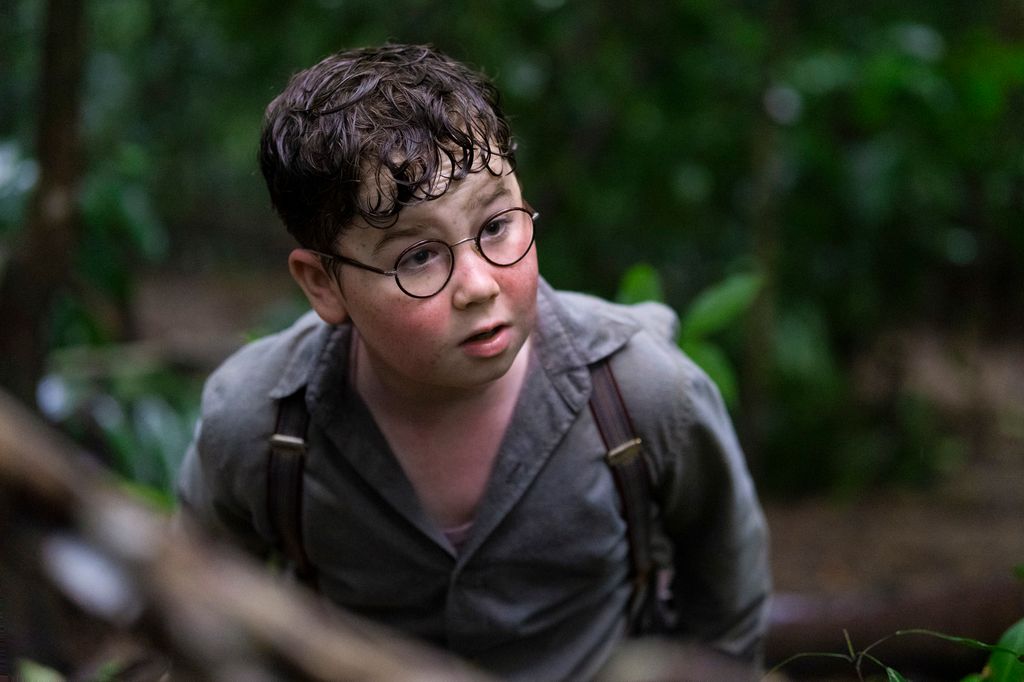
Thorne’s script expands thoughtfully on the novel’s themes without straying far from its essence. Each episode delves deeper into the psychological unraveling, with moments of surreal horror that amplify the dread. The island, filmed on location in Malaysia, is rendered as both paradise and prison: lush jungles, crashing waves, and golden beaches contrast sharply with the boys’ descent. Cinematography captures the oppressive heat, the encroaching shadows, and the visceral gore of hunts, making the environment feel alive and malevolent. Folk-horror elements creep in—hallucinations, ritualistic chants, and a mounting sense of the supernatural—though the “beast” remains, as in the book, a projection of the boys’ inner fears.
The performances from the young, largely debut cast are nothing short of remarkable. Sawyers brings nuance to Ralph’s growing despair as idealism gives way to helplessness. Pratt’s Jack is magnetic and terrifying, his transformation from choirboy to painted savage feeling disturbingly organic. McKenna’s Piggy is heartbreaking—vulnerable, intelligent, and painfully aware of how his differences make him a target. Talbut’s Simon conveys quiet profundity, his tragic fate hitting with devastating force. The ensemble of over 30 boys, including the twins Sam and Eric (Noah and Cassius Flemyng), creates a believable micro-society where alliances shift and brutality spreads like contagion.
What makes this adaptation so nerve-shredding is its refusal to soften the material for modern audiences. The violence is sudden and shocking—blood-soaked hunts, beatings, and worse—portrayed with unflinching realism that has left viewers reeling. Critics and audiences alike have described it as “brutal,” “surreal horror,” and “sickening,” with one review noting it makes viewers “feel sick throughout.” The series doesn’t shy away from the novel’s bleak allegory: the fragility of democracy, the allure of authoritarianism, the darkness lurking in every human heart. In 2026, amid global anxieties about division and power, the story feels eerily prescient. Thorne has said he aimed to dig into the “tendency to bad behaviour” without making it depressing, preserving insight and humanity amid the chaos.
Yet not every reaction has been glowing. Some viewers have found the pacing uneven or criticized stylistic choices, like certain camera techniques in early episodes that felt distracting. A few have called it “unwatchable” due to its intensity or perceived deviations, though many praise its fidelity and power. Golding’s daughter, Judy Golding, has endorsed the series as “terribly good,” believing her father would have approved. Online discussions rage—some hail it as a “first-class adaptation done right,” others find it more unsettling than previous film versions from 1963 and 1990.
By the final episode, the question shifts from survival to something far more profound: what’s left when the rules disappear? The boys’ moral freefall strips away illusions of innocence, exposing the thin veneer of civilization. The arrival of rescue—symbolized by the naval officer—offers no tidy redemption; instead, it forces confrontation with what they’ve become.
In an era of polished escapism, BBC’s Lord of the Flies demands attention. It’s sharp, raw, and relentless—a haunting reminder that savagery isn’t confined to deserted islands. Viewers aren’t just watching a classic reborn; they’re witnessing humanity at its most vulnerable and vicious. Whether it terrifies or enlightens, this adaptation lingers long after the credits roll, proving Golding’s warning remains as urgent as ever.