In the dim glow of a late-night Netflix scroll, few discoveries feel as serendipitous as stumbling upon The Good Liar. Released in 2019, this sly London-set thriller—directed by Bill Condon and adapted from Nicholas Searle’s 2015 novel—pairs two titans of the screen, Ian McKellen and Helen Mirren, in a dance of duplicity that unfolds like a well-worn Chesterfield armchair: comfortable at first glance, but harboring secrets in its creases. Now, as the streaming giant prepares to wave it goodbye on October 10, 2025—just two weeks away for UK viewers—the departure stirs a peculiar ache. It’s not just the loss of a film; it’s the evaporation of those rainy evenings spent unraveling its layers, chuckling at its cheeky asides, and marveling at how two performers in their twilight years could still command the frame with such effortless menace and mirth. With only days left to queue it up, there’s an urgent poetry in one final viewing: a chance to retrace the foggy Thames-side paths where trust erodes like chalk cliffs, and to bid adieu to a story that reminds us why cinema’s greatest cons are the ones that linger in the mind.
At its core, The Good Liar is a tale of calculated seduction, both romantic and criminal, set against the genteel backdrop of contemporary London and shadowed by the ghosts of post-war Europe. Roy Courtnay (McKellen), a silver-haired septuagenarian with the gait of a retired diplomat and the soul of a fox in the henhouse, spots his latest opportunity on a discreet online dating site. His target: Betty McLeish (Mirren), a poised widow whose Oxford pedigree and plump pension pot—north of £2 million—make her the perfect mark for a lifetime grifter. What begins as a polite dinner at a harborside bistro spirals into an intricate game of cat-and-mouse, as Roy feigns frailty to infiltrate Betty’s leafy Hampstead home, enlisting her in a joint “investment” scheme that’s anything but. Along the way, Roy juggles accomplices like Vincent (Jim Carter), a rumpled accountant with a penchant for pilfering, and a ragtag crew of Eastern European heavies who add a dash of international intrigue to the heist.
But this isn’t your standard sting operation, the kind where the mark is a wide-eyed ingenue and the reveal a gleeful gotcha. Searle’s novel, deftly scripted by Jeffrey Hatcher, layers in flashbacks to 1943 Berlin, where young versions of our leads—played with raw vulnerability by Nell Williams as Lili (Betty’s true self) and Laurie Davidson as Hans (Roy’s wartime alias)—navigate the rubble of Nazi occupation. These interludes, shot in desaturated tones that contrast the film’s otherwise polished palette, unearth a buried history of betrayal: a tutor’s illicit advances, a family’s shattering under Allied bombs, and a girl’s hard-won transformation into a survivor who learns that survival demands its own brand of falsehood. As the timelines converge, what starts as a cozy con caper darkens into a revenge saga, probing the long tail of wartime atrocities and the moral quicksand of deception. Roy’s limp, it turns out, is as fabricated as his stock tips; Betty’s naivety, a velvet glove over an iron fist. Their evolving rapport—tea-sipping chats laced with loaded pauses—builds a tension that’s less explosive than insidious, culminating in a Berlin jaunt where old sins resurface like bodies from the Spree.
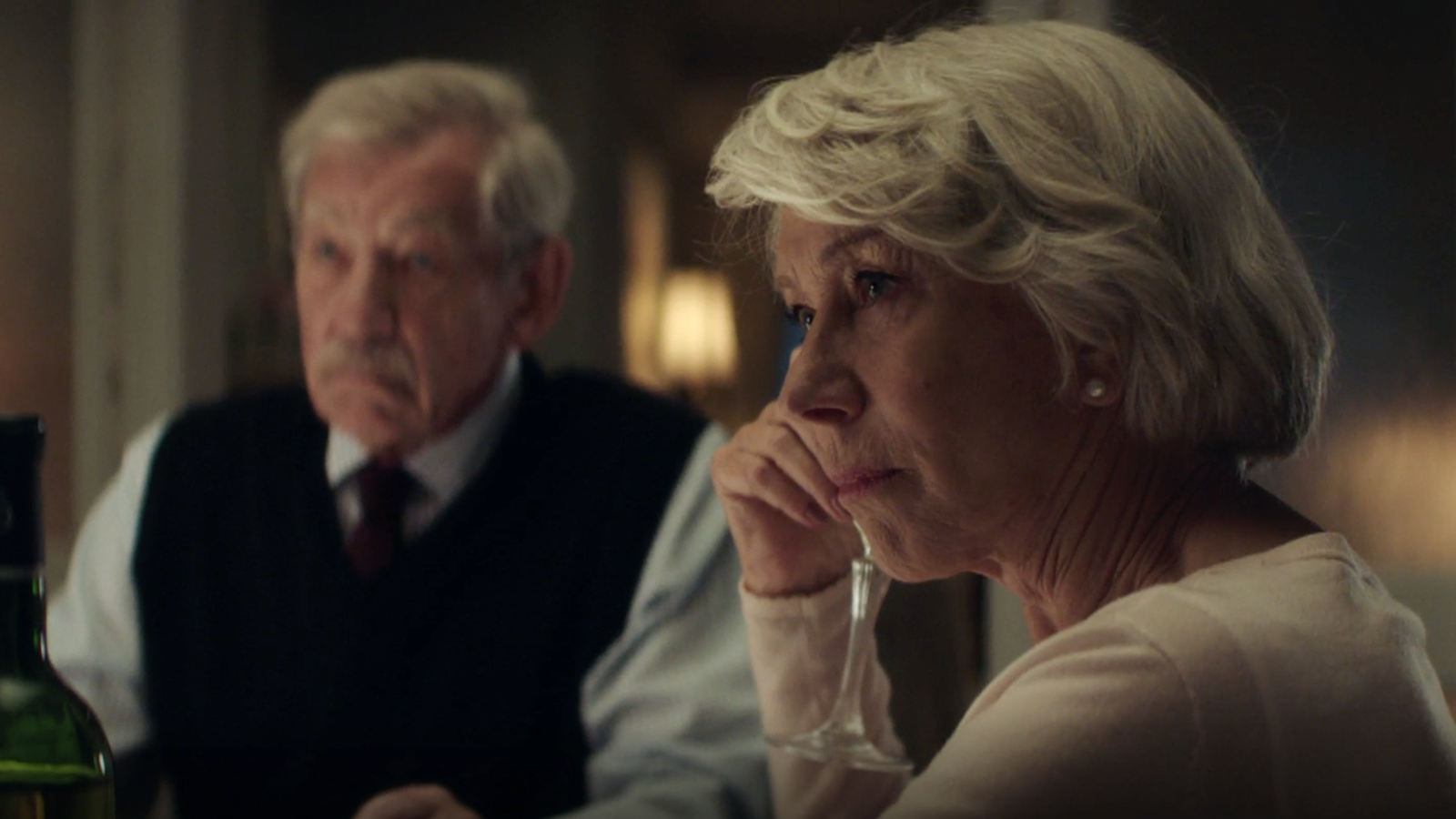
Condon, whose directorial resume spans the lavish (Beauty and the Beast) to the intimate (Gods and Monsters, which netted McKellen an Oscar nod), orchestrates this with a Hitchcockian flair tempered by restraint. Tobias A. Schliessler’s cinematography captures London’s duality: the sun-dappled canals of Little Venice masking the grit of Charing Cross Underground, where a pivotal chase pulses with subterranean dread. Carter Burwell’s score—a lilting waltz of unease, evoking his work on Carol—underscores the emotional vertigo, swelling during Roy’s monologues on “the art of the long game” and fading to whispers in Betty’s quiet moments of doubt. Production kicked off in April 2018 across London and Berlin, a trans-European shoot that mirrored the story’s fractured geographies. With a modest $10 million budget, the film punched above its weight, grossing $33.9 million worldwide—peaking at $5.6 million in its US opening weekend amid competition from blockbusters like Ford v Ferrari. It was no tentpole, but in an era of superhero sprawl, its adult-oriented elegance felt like a quiet rebellion, a throwback to the Golden Age thrillers of the 1970s, where plot was king and charisma the crown.
Of course, the true alchemy here is McKellen and Mirren, whose first big-screen pairing—despite decades of theatrical overlap—ignites like dry tinder. McKellen, 80 at release, channels Roy with a serpentine charm that’s equal parts Gandalf’s wisdom and Magneto’s ruthlessness: a twinkle in the eye as he spins yarns about phantom investments, a subtle hunch that unravels into feral cunning during a brutal back-alley brawl. It’s a role tailor-made for his chameleon gifts, allowing him to slip between avuncular warmth and chilling calculation, his voice dropping to a gravelly purr in confessionals that double as soliloquies. “Acting is lying for a living,” McKellen once quipped in interviews, and here he embodies it, drawing on his Shakespearean roots to infuse Roy’s monologues with tragic gravitas. Watch him in the film’s nerve-shredding tube sequence: feigning vulnerability one beat, striking like a coiled spring the next—it’s a reminder of why he’s a national treasure, capable of making villainy feel like a velvet trap.
Mirren, then 74 and fresh off The Queen‘s Oscar glory, counters with a masterstroke of restraint as Betty. Her patrician poise—those arched brows, that measured laugh—belies a storm of suppressed fury, revealed in glacial increments. Early scenes paint her as the quintessential English rose: widowed, bookish, blissfully unaware as she wires funds to Roy’s phantom portfolio. But as the layers peel, Mirren unveils a woman forged in fire, her eyes hardening from doe-like trust to diamond-cut resolve. It’s a performance of exquisite economy, blending vulnerability with veiled steel—think Prime Suspect‘s Jane Tennison, but laced with the quiet rage of a lifetime’s buried trauma. Their chemistry is the film’s pulse: a waltz of feints and parries, where a shared glance over clotted cream conveys more than pages of dialogue. Off-screen, the duo’s real-life neighborly bond in London’s Wapping added unscripted ease; McKellen later joked they “rehearsed over gin and tonics,” while Mirren praised his “mischievous intellect” as the perfect foil to her precision.
Supporting turns add texture without stealing focus. Russell Tovey simmers as Stephen, Betty’s protective grandson (and more), his boyish features twisting into wary scowls during tense family dinners. Jim Carter brings world-weary heft to Vincent, the reluctant enabler whose moral qualms hint at the con’s human cost. Smaller roles—Lucian Msamati’s sly Beni, Jóhannes Haukur Jóhannesson’s hulking Vlad—infuse the criminal underbelly with multicultural grit, a nod to London’s evolving mosaic. Yet it’s the leads who anchor the absurdity, turning contrived twists into credible catharsis. The script’s labyrinthine reveals—DNA tests via heirloom lockets, coerced betrayals—teeter on melodrama, but McKellen and Mirren sell them with such conviction that the final confrontation lands like a gut punch, not a groaner.
Reception upon release was a mixed bag, mirroring the film’s thematic ambiguity: 64% on Rotten Tomatoes from 165 reviews, with critics lauding the stars while nitpicking the plot’s contrivances. Roger Ebert’s Peter Sobczynski awarded 2.5 stars, calling it “just good enough to suggest what Hitchcock might have done on a second pass,” praising a taut Underground set-piece but decrying character actions driven by “plot necessity.” The Guardian’s Wendy Ide gave three stars, hailing the duo’s “sparky best” in a “Russian doll of deceptions,” though flashbacks felt “ineffective.” Variety swooned over their “cat-and-mouse duet turned elegant waltz,” while The Wrap deemed it “torpid when it should be thrilling,” a rare misfire for Condon. Audiences, however, warmed more: a “B” CinemaScore and 4/5 on PostTrak, with fans raving about the “puzzle-box” narrative and “didn’t-see-that-coming” finale. On IMDb, it holds a solid 6.7/10 from over 50,000 votes, beloved by those craving grown-up suspense sans gore. Nods rolled in too: Mirren snagged AARP and Satellite Award nominations for Best Actress, while the film contended for Saturn’s Best Action/Adventure. The Queerties honored McKellen’s turn, underscoring its queer-coded undercurrents in a story of hidden selves.
Thematically, The Good Liar grapples with the elasticity of truth in an age of deepfakes and dating app facades. Roy’s deceptions echo broader anxieties—scams that prey on loneliness, the fragility of memory post-trauma—but it’s refreshingly unpretentious, more The Sting than Gone Girl. Flashbacks to wartime Berlin aren’t mere backstory; they interrogate how lies become lifelines, turning victims into virtuosos of survival. Betty’s arc, in particular, subverts the “frail widow” trope, offering a feminist riposte to con-man classics like Catch Me If You Can. Violence flares unexpectedly—a savage beating here, a throat-slashing there—jarring against the chintzy cosiness, a deliberate undercut to the genre’s polish. At 109 minutes, it’s taut yet leisurely, inviting rewatches to spot foreshadowing: that lingering shot of a childhood locket, Roy’s offhand quip about “old wounds.”
As October 10 looms, the Netflix exodus feels poignant in 2025’s content churn, where hits vanish like smoke. Yet The Good Liar endures beyond streams—available on disc, Prime, or iTunes— a testament to its analog soul. It’s the film you press on skeptical friends: “Trust me, it’s better than it sounds.” In an industry fixated on youth and flash, it celebrates seasoned storytellers, proving that at 70 or 80, the best performances are marathons, not sprints. McKellen and Mirren don’t just act; they ensnare, leaving you questioning every smile. So, cue it up one last time on the red-N app: savor the setup over a nightcap, gasp at the gut-turn in Berlin’s chill, and toast to the liars who make truth worthwhile. When the credits fade—Burwell’s strings sighing farewell— you’ll feel not loss, but the quiet thrill of having been magnificently duped. After all, in Roy’s world, the real con is believing anything ends cleanly.