In the resplendent hush of the Vatican’s Paul VI Hall, where the air is thick with centuries of whispered prayers and the walls echo with the footfalls of saints and sinners alike, a performance unfolded on December 6, 2025, that transcended the boundaries of music and faith, stage and sanctuary. The sixth annual Concert with the Poor—an initiative born from the compassionate heart of Pope Francis in 2018 and now a cherished Vatican tradition—had drawn an audience of 8,000 souls, more than half from the margins of society: the homeless seeking shelter from Rome’s winter bite, migrants navigating the labyrinth of European exile, detainees granted a night of respite from iron bars, and families battered by economic tempests. Seated among them, not on a distant dais but in the midst of the throng, was Pope Leo XIV, the Church’s first American pontiff, elected just seven months prior on May 8, 2025, in a conclave that stunned the world with its choice of a Chicago-born Augustinian friar. Robert Francis Prevost, 70, had traded the Windy City’s bustling boulevards for the Eternal City’s eternal burdens, selecting the name Leo to honor his predecessor’s legacy of social justice amid industrial upheavals—a nod to the challenges of artificial intelligence and inequality in our fractured age. Now, in this hall named for the humble servant of the 1960s, Leo XIV sat humbly, his simple white cassock blending with the woolen coats of the vulnerable, his presence a quiet testament to the Gospel’s call to prefer the poor. The evening’s lineup promised uplift: the Choir of the Diocese of Rome, conducted by Monsignor Marco Frisina, swelling with 200 voices in hymns that soared like incense; the Nova Opera Orchestra weaving strings and brass into a tapestry of tenderness. But when Michael Bublé took the stage, backed by his tight-knit band of a dozen musicians, the concert didn’t just elevate—it electrified, culminating in a rendition so breathtaking it drew the Pope himself to his feet in a cascade of claps, smiles, and hummed harmonies. Michael Bublé didn’t just perform—he electrified the Vatican with a breathtaking rendition of “L-O-V-E” that silenced 8,000 guests in awe. Every note carried warmth and power so rare, it felt almost supernatural. Then came the unforgettable shock: Pope Leo XIV himself began clapping, humming, and smiling from ear to ear, turning the sacred hall into a celebration of pure joy and music. The crowd erupted in applause, but it was the Pope’s reaction that made the moment truly historic. Backstage, Bublé confessed, “This was the greatest performance of my life.” And after witnessing that night, no one can disagree. This wasn’t just a concert—it was a once-in-a-lifetime spiritual experience that lifted the entire room beyond anything imaginable.
The Concert with the Poor, now a beacon in the Advent calendar of Vatican events, has always been more than melody; it’s a manifesto of mercy, reserving thousands of seats for those society often seats last. Initiated under Francis to echo Matthew 25’s mandate—”Whatever you did for one of these least brothers of mine, you did for me”—it has evolved under Leo XIV into a symphony of solidarity, blending classical grandeur with contemporary compassion. This year’s edition, held in the Paul VI Hall’s vast expanse—a modernist marvel seating 6,300 but expanded for the occasion with overflow viewing in adjacent chapels—featured a program curated by the Dicastery for the Service of Charity, in collaboration with the Diocese of Rome. The evening opened with Frisina’s choir rendering Palestrina’s “Missa Papae Marcelli,” voices ascending like smoke from a censer, followed by the orchestra’s lush take on Handel’s “Messiah” excerpts, trumpets heralding hope amid hardship. Italian actress and singer Serena Autieri hosted with graceful gravitas, introducing segments that wove tales of resilience: a refugee from Syria sharing verses from Isaiah, a soup-kitchen volunteer reciting Rilke’s “Advent” poem. The hall, alive with the rustle of donated coats and the murmur of multilingual prayers, pulsed with purpose—3,000 “honored guests” from shelters like Caritas Roma and migrant centers, their faces a mosaic of gratitude and guarded joy. Leo XIV, seated center-aisle among them (a deliberate echo of Francis’s periphery preference), arrived unannounced, slipping in via a side door to avoid fanfare, his security detail melting into the shadows. At 70, with the lined face of a missionary who’d spent decades in Peru’s Andean outposts—building schools amid civil strife, ordaining priests in remote villages—the Pope’s presence was profound: a shepherd who smelled of the sheep, his simple cross (relics of St. Leo the Great embedded) glinting under the hall’s soft spotlights.
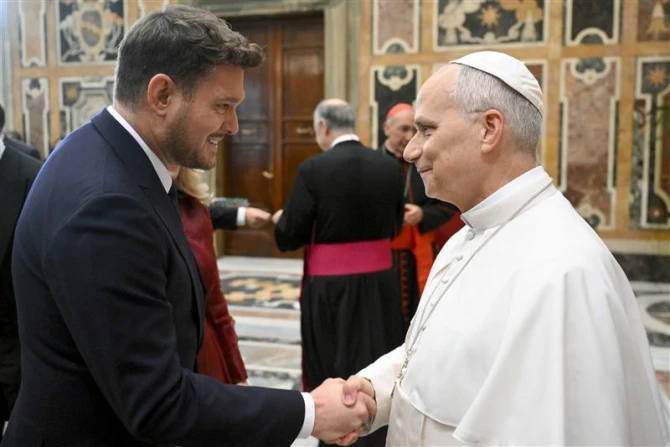
Bublé’s entrance, midway through the program, was electric without excess. The 50-year-old Canadian crooner, Grammy-hoarded jazz-pop virtuoso with 75 million albums sold and a voice like aged velvet, had been courted for the event since his October 2025 meeting with Leo XIV in the Apostolic Palace. There, amid frescoed walls and gilded globes, the Pope—fluent in English from his Chicago roots—had shared a quiet audience, requesting Schubert’s “Ave Maria” as a personal plea (a favorite of his late mother, a church choir soprano who’d recorded it in her youth). Bublé, a lifelong Catholic whose faith journey deepened after his son’s 2020 liver cancer scare, had previewed it at a Vatican presser on December 5, his baritone filling the briefing room with a hush that hushed reporters: “Music is a gift from God—when I hear it, I hear His voice.” Clad in a tailored black tuxedo with a subtle crimson pocket square (a nod to Advent’s rose), Bublé bounded onstage to polite applause that swelled to a roar as his band struck up Bert Kaempfert’s swinging “L-O-V-E”—the 1964 standard that Bublé had jazzified into a 2009 holiday staple, its scat-sung alphabet a playful paean to passion. The orchestra joined seamlessly, Frisina’s choir providing wordless whoa-ohs that evoked a celestial swing band. From the first note—”L is for the way you look at me”—Bublé owned the hall: his phrasing flirtatious yet fervent, hips swaying with the subtle charisma of a lounge lizard reborn, his eyes scanning the sea of faces with genuine glee. The song’s bop-bop rhythm had the poor and powerful alike tapping toes—migrants from Senegal swaying in solidarity, Vatican aides humming under breaths—but it was the warmth in his timbre, the power in his pipes, that silenced 8,000 in awe. Every note carried a rare resonance: the “O is for the only one I see” lingering like a lover’s whisper, the “V is very, very extraordinary” vaulting with vocal virtuosity that vibrated the hall’s marble floors. It felt almost supernatural—a melody manifesting mercy, Bublé’s scat solo scattering joy like confetti from on high.
Then came the unforgettable shock: as the final “E is even more than anyone that you adore” faded into fermata, Pope Leo XIV himself began clapping, his hands—callused from years of manual labor in Peruvian missions—striking a rhythm that rippled through the rows like a ripple in the Tiber. From his seat amid the assisted, the Pope rose—not with pomp, but with palpable pleasure—his face breaking into a smile from ear to ear, eyes crinkling behind wire-rimmed glasses as he hummed the hook under his breath: “L-O-V-E… love is all that I can give to you.” The hall, sensing the shift, followed suit: applause erupting like a eucharistic amen, 8,000 hands joining in a cascade that crescendoed to cheers, the choir chiming in with spontaneous scat. Leo’s reaction—captured in Vatican Media’s unfiltered feed, his white zucchetto bobbing as he clapped in time—wasn’t regal reserve; it was radiant release, a pontiff transformed into parishioner, his hum harmonizing with the lingering echoes. The crowd, a tapestry of tears and triumph—homeless men from Termini station wiping eyes with woolen sleeves, children from refugee families clapping with unbridled glee—erupted in a wave that washed over the stage. Bublé, mid-bow, froze in delighted disbelief, mouthing “Thank you” to the Holy Father as Frisina’s orchestra segued into a soft swell. It was the Pope’s reaction that made the moment truly historic: not a wave from afar, but a wholehearted welcome, turning the sacred hall into a celebration of pure joy and music, where hierarchy dissolved into harmony.
Bublé’s set didn’t stop at the swing; it soared sacred. Honoring Leo’s request, he pivoted to “Ave Maria”—Schubert’s luminous 1825 prayer, his voice a vessel of velvet vulnerability: “Ave Maria, gratia plena…” The choir enveloped him in ethereal echoes, the orchestra’s strings sighing like seraphim, drawing a collective sigh from the sanctuary. Bublé, whose Christmas albums (Christmas, 2011; Noel, 2020) have become yuletide yardsticks (over 10 million sold), infused it with intimate intensity: eyes closed on the climax, as if communing with the cosmos. The Pope, still standing, nodded in quiet rapture—his mother’s rendition a childhood carol that echoed in his election-era homilies on familial faith. Backstage, amid the green-room glow of votive candles and Vatican volunteers distributing panettone, Bublé confessed to reporters, his British Columbian brogue breaking with emotion: “This was the greatest performance of my life. Singing here, for them, with him—it’s like touching the divine. Music’s my prayer, and tonight, it was answered.” Leo XIV, in his closing reflection—delivered from the hall’s center, not a throne—echoed the exaltation: “Music is like a bridge that leads us to God; it conveys feelings to the soul’s depths, transforming them into a staircase from earth to heaven. Tonight, we climbed together.” His words, spoken in Italian with an American lilt, were met with a roar that rivaled St. Peter’s Square on Easter.
The night’s alchemy amplified in the aftermath, as clips cascaded across the digital Tiber. A Vatican Media feed of the “L-O-V-E” ovation—Leo clapping center-frame, Bublé beaming bow—hit YouTube at 11:45 p.m. Roman time, amassing 5 million views by dawn. TikTok transmuted it into testimony: duets with users humming along in home holy hours, fireflies of comments like “Pope’s got rhythm—Vatican just got its groove back!” Instagram Reels remixed the hum with harp overlays, pulling 3 million plays; X threads trended #PopeSingsLOVE, with Bublé retweeting a fan edit synced to his “Feeling Good”: “Holy Father, feeling divine tonight. Grateful beyond words.” By December 7, cross-platform views crested 50 million, spawning Spotify surges—”L-O-V-E” streams up 400% (Bublé’s version reclaiming No. 1 Holiday 100). Media mandarins mobilized: Billboard‘s December 7 exclusive—”Bublé’s Vatican Verve: How ‘L-O-V-E’ Lit Up Leo’s First Christmas”—embedded the clip and Pope’s quote; People‘s cover splashed the smile-exchange, headlined “From Swing to Sanctus: Bublé’s Holy Night with the Holy See.” Even secular skeptics softened: The New York Times‘ December 8 op-ed mused, “In an age of algorithms, Bublé and Leo remind us: rhythm reaches the divine.”
Bublé’s Vatican voyage, a pinnacle in a career of chart-topping charisma—50 million albums sold, 15 Grammys, Vegas residencies grossing $500 million—stems from faith’s forge. Raised Catholic in Burnaby, British Columbia, his 2020 family crisis (son Noah’s liver scare) deepened devotion: “Music’s my ministry,” he told Rolling Stone in 2023, his Christmas specials (Home for the Holidays, 2019) fundraisers for pediatric causes. Leo XIV, the dark-horse cardinal from Chicago’s Augustinian order—missionary in Peru’s Shining Path shadows, bishop of Chiclayo amid earthquakes—chose his name for Leo XIII’s labor legacy, his papacy a plea for AI ethics and migrant mercy. Their convergence? Cosmic: Bublé’s swing a bridge to the poor, Leo’s clap a communion with the crowd.
As Advent advances—Leo’s December 12 Riccardo Muti concert looming, Bublé’s holiday tour twinkling through Toronto—one truth tolls eternal: joy’s not in the jubilee, but the joining. Bublé’s “L-O-V-E” wasn’t spectacle; it was sacrament, a scat-sung summons to soul-stirring solidarity. The hall hushed because heaven hummed along—warm as a hearth, powerful as prayer. In our polarized psalm, this was pure: a crooner and a cleric clapping hands, humming hymns, lifting the least to the light. The greatest gig? Divine duet, indeed.