At 09:46 AM on Thursday, July 24, 2025, the enigmatic bond between Queen Elizabeth II and Princess Diana continues to captivate the public imagination, nearly eight years after the queen’s death on September 8, 2022, and almost 28 years since Diana’s tragic passing on August 31, 1997. Both figures, now immortalized in history, shared a relationship marked by admiration, tension, and unspoken complexities. Yet, despite the passage of time and a wealth of anecdotal evidence, the question persists: did they truly hold a deep mutual affection, or was their connection a carefully curated facade shaped by royal duty? The lack of definitive answers underscores a narrative that remains as elusive as it is compelling.
Early Encounters: A Promising Start
Diana Frances Spencer entered the royal orbit long before her 1981 marriage to Prince Charles. Born on July 1, 1961, at Park House on the Sandringham estate, she grew up in proximity to the royal family, her grandmothers—Cynthia Spencer and Ruth Roche—serving as ladies-in-waiting to Queen Elizabeth The Queen Mother. This closeness fostered an early familiarity, with Diana playing as a child with Princes Andrew and Edward, though her interactions with the future queen were limited. When Charles, under pressure to marry in his early 30s, began courting the 19-year-old Diana in 1980, Queen Elizabeth reportedly welcomed her as a suitable match. The engagement announcement in February 1981 and the lavish July wedding at St. Paul’s Cathedral cemented Diana’s role, with the queen initially viewing her as a breath of fresh air for the monarchy.
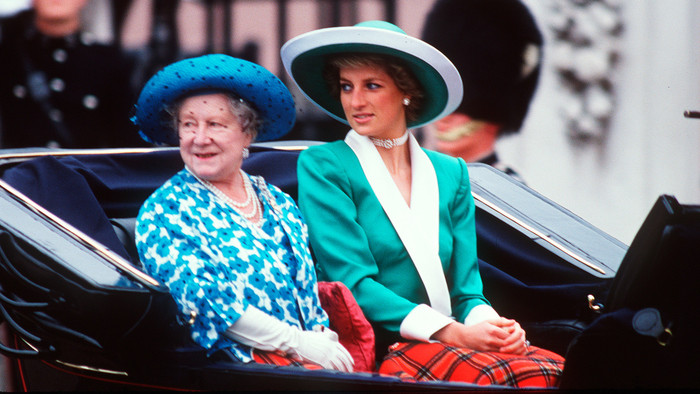
Early signs suggested mutual respect. Diana’s first official appearance at the Trooping the Colour in June 1981 and her solo engagement to switch on Regent Street’s Christmas lights in November showcased her charm, which the queen seemed to appreciate. Biographer Andrew Morton noted that Diana was “terrified” of her mother-in-law initially, adhering to formal curtsies, but the queen’s approval of the union hinted at a willingness to guide her new daughter-in-law. Photographs from this period, such as their joint appearance at the 1982 State Opening of Parliament, depict a poised Diana alongside a composed Elizabeth, suggesting a relationship grounded in protocol rather than personal warmth.
The Strain of a Crumbling Marriage
The cracks began to show as Diana’s marriage to Charles unraveled. By 1986, both had embarked on extramarital affairs—Charles with Camilla Parker Bowles and Diana with James Hewitt—exposing a public rift that strained her relationship with the royal family. Diana’s emotional volatility, documented in Morton’s 1992 book Diana: Her True Story, contrasted with the queen’s reserved demeanor. In 1993 tapes, later aired in the 2017 documentary Diana: In Her Own Words, Diana recounted sobbing to the queen for help with her marriage, only to receive a curt, “I don’t know what you should do.” This moment, whether a reflection of Elizabeth’s discomfort or a lack of guidance, marked a turning point, suggesting a disconnect rather than disdain.
The queen’s frustration grew as Diana’s popularity eclipsed her own. During joint tours, Charles reportedly resented the crowd’s focus on his wife, a sentiment the queen may have shared, as historian Arianne Chernock suggests, due to the “complicated little dance” of their roles. Diana’s unconventional charity work—hugging AIDS patients and walking through minefields—earned global acclaim but clashed with the monarchy’s traditional image, drawing criticism from figures like philosopher Anthony O’Hear, who labeled her “self-indulgent.” The queen’s silence on these critiques left their dynamic ambiguous, hinting at a possible tension beneath the surface.
A Fractured Bond and the Divorce
The 1992 separation, followed by the 1995 Panorama interview where Diana admitted her affair and questioned Charles’s fitness to reign, pushed their relationship to a breaking point. The queen, prompted by public and political pressure, wrote to both in December 1995, urging a divorce. Despite her reluctance, she advocated for Diana to retain her HRH title, a gesture overruled by Charles. This act suggests a degree of compassion, yet Diana’s portrayal of the royal family as “uncaring” in the interview painted Elizabeth as complicit, a narrative the queen never publicly countered.
The divorce, finalized on August 28, 1996, stripped Diana of her HRH status, a decision that some interpret as a royal rebuke. However, evidence of lingering respect emerges in the queen’s actions post-divorce. Diana continued some royal duties, and Elizabeth’s approval of her charitable endeavors—such as her 1991 Pakistan trip for drug rehabilitation—indicates a pragmatic acceptance. The complexity deepened with Diana’s death a year later, when the queen faced criticism for staying at Balmoral, prompting her rare televised address on September 5, 1997, praising Diana’s “energy and commitment.”
Aftermath and Mutual Affection: A Hidden Truth?
Diana’s death at 36 in a Paris car crash, chased by paparazzi, tested the queen’s response. Her initial silence and the decision to keep William and Harry at Balmoral drew public ire, but her eventual bow as Diana’s coffin passed Buckingham Palace on September 6, 1997, and the half-staff flag signaled respect. An unearthed letter from six days later, cited by Marie Claire, revealed Elizabeth’s private sorrow, calling Diana “an exceptional and gifted human being” and admiring her devotion to her sons. This suggests a personal fondness that public narratives often overlook.
Posts found on X reflect a split sentiment: some claim the two “remained close friends” and spoke daily after the divorce, while others insist the queen “forced the marriage” due to Camilla’s unsuitability. These claims, lacking verification, highlight the uncertainty surrounding their bond. Biographer Ingrid Seward argues the queen admired Diana’s mothering of William and Harry, a view supported by the naming of Princess Charlotte Elizabeth Diana in 2015, blending royal and Spencer legacies. Yet, the queen’s private thoughts, locked in unshared correspondence, leave the depth of her affection speculative.
A Critical Examination of the Narrative
The official royal narrative portrays a relationship of duty rather than intimacy, with the queen as a stabilizing force and Diana as a disruptor. This framing, however, glosses over contradictions. The queen’s initial support for Diana’s engagement, contrasted with her apparent withdrawal during the marriage’s collapse, suggests a pragmatic shift rather than personal enmity. The 1992 Windsor Castle summit, where Elizabeth and Prince Philip urged Charles and Diana to prioritize the monarchy, indicates an attempt to manage rather than resolve their issues, raising questions about accountability.
Critics argue the monarchy’s emotional restraint—evident in the queen’s limited guidance to Diana—exacerbated their rift. Diana’s emotional outbursts, seen as destabilizing, may have been a cry for understanding unmet by a queen trained to suppress vulnerability. The public’s romanticization of Diana, amplified by media like The Crown, often casts Elizabeth as cold, a portrayal challenged by her post-death tributes. The lack of direct testimony from either, now deceased, fuels skepticism about whether the affection was genuine or a public relations necessity.
The Unresolved Mystery
As of July 24, 2025, the relationship remains a puzzle. The queen’s long reign, marked by 70 years of stoicism, and Diana’s brief but transformative 15 years as a royal, created a dynamic shaped by contrasting personalities and roles. Their mutual respect—evident in shared engagements and the queen’s post-divorce gestures—coexisted with undeniable strain, particularly during the marriage’s public breakdown. Yet, the absence of private letters or unfiltered accounts leaves the question of true affection unanswered.
The Spencer family’s ties to the royals, Diana’s childhood proximity, and the queen’s admiration for her grandsons’ mother suggest a foundation of goodwill. However, the institutional pressures of the monarchy, Diana’s rebellion, and the queen’s adherence to protocol likely limited deeper connection. The mystery endures, a testament to two women whose lives intersected at a pivotal moment, leaving behind a legacy of intrigue rather than clarity.
Their deaths—Diana’s sudden and tragic, the queen’s after a long reign—have only deepened the enigma. For historians and the public, the search for the truth continues, sifting through fragmented evidence and competing narratives. Whether they loved each other as individuals or merely fulfilled their roles remains an open question, a silent dialogue lost to history.