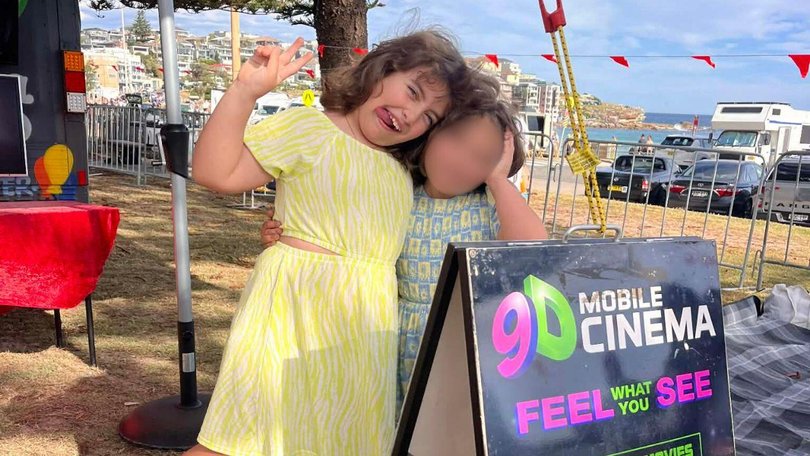
In the quiet suburb of Woollahra, Sydney, hundreds of mourners gathered on a somber Thursday morning to pay their final respects to 10-year-old Matilda, the youngest life stolen in the devastating terror attack at Bondi Beach. The funeral service, held just days after the horrific shooting that claimed 15 lives, marked the beginning of a series of farewells for victims of what authorities have described as an antisemitic terrorist act inspired by the Islamic State group. As family, friends, and community leaders filed into the venue, the air was heavy with grief, punctuated by small symbols of hope—bumblebee balloons bobbing gently in the breeze and stickers bearing Matilda’s name adorning lapels and hands.
Matilda, a bright and spirited girl whose infectious joy touched everyone around her, had been attending a joyful Hanukkah celebration, “Chanukah by the Sea,” at Archer Park beside the iconic Bondi Beach on Sunday, December 14. What should have been an evening of light, music, and community turned into a nightmare when two gunmen—a father and his 24-year-old son—opened fire on the crowd of about 1,000 people marking the first night of the Jewish festival. Matilda succumbed to her injuries in a Sydney children’s hospital that night, becoming the youngest of the 15 fatalities in one of Australia’s deadliest modern terror incidents.
At the funeral, Matilda’s aunt, Lina Chernykh, delivered a poignant tribute that captured the profound loss felt by the family. Speaking through tears, she described her niece as a joyous child who “spread love everywhere she went.” Chernykh urged those present to transform their anger and sorrow into acts of kindness, saying, “Take your anger and… just spread happiness and love and memory for my lovely niece.” In a moment of quiet hope amid the devastation, she added, “I hope maybe she’s an angel now. Maybe she will send some good vibes to the world.” Chernykh’s words painted a vivid picture of the family’s shattered world, noting the unbearable pain of Matilda’s parents and the confusion of her younger sister, who was inseparable from her. “I look at their faces [and] I don’t know if they will be ever happy again,” Chernykh said, revealing that the little sister was so overwhelmed she “doesn’t have enough tears to cry.”
Matilda’s mother, Valentyna, had earlier shared the family’s heartbreaking backstory at a floral memorial near Bondi Pavilion. The family had emigrated from Ukraine more than a decade ago, fleeing conflict in search of safety and a better life in Australia. “I couldn’t imagine I’d lose my daughter here,” Valentyna said, her voice breaking. “It’s just a nightmare.” Teachers and community members echoed these sentiments, remembering Matilda as a “bright, joyful, and spirited child who brought light to everyone around her.” A former instructor at the Harmony Russian School of Sydney, where Matilda had studied, described her as a student whose memory would forever remain in their hearts.
The service drew notable figures from Australia’s political and Jewish community spheres, underscoring the national impact of the tragedy. Among the attendees were Alex Ryvchin, co-chief executive of the Executive Council of Australian Jewry; Opposition Leader Sussan Ley; and federal MP Julian Leeser. Mourners clutched flowers, balloons, and personal mementos, creating a sea of quiet solidarity in the face of unspeakable horror.
The attack unfolded with chilling precision on that Sunday evening around 6:47 pm. The perpetrators, identified as 50-year-old Sajid Akram and his son Naveed Akram, arrived in a vehicle displaying Islamic State flags. Armed with legally obtained firearms—including rifles and shotguns—the duo fired over 100 rounds from a footbridge overlooking the celebration. The rampage began when a courageous Russian-Jewish couple, Boris and Sofia Gurman, spotted the flags and attempted to intervene, only to become the first victims. Chaos ensued as families scattered, some shielding children with their bodies, while lifeguards from the nearby Bondi Surf Lifesaving Club heroically used surfboards as stretchers to evacuate the wounded under fire.
Acts of bravery emerged amid the terror. Bystander Ahmed al-Ahmed, hailed as a hero by Prime Minister Anthony Albanese and NSW Premier Chris Minns, tackled one of the gunmen and disarmed him. Another man, Reuven Morrison, charged the scene throwing bricks before being fatally shot. Police responded swiftly, neutralizing the elder Akram at the scene and critically injuring the younger, who was later charged with 59 offenses, including 15 counts of murder and committing a terrorist act.
The 15 victims represented a cross-section of the vibrant Bondi Jewish community and beyond. Among them were respected Chabad rabbis Eli Schlanger and Yaakov Levitan, who left behind young families; an 87-year-old Holocaust survivor, Alex Kleytman, who died shielding his wife; and others including community members, sports club figures, and international visitors. Dozens more were injured, including children and police officers, with improvised explosive devices found in the attackers’ vehicle heightening fears of an even deadlier plot.
In the days following the attack, Bondi Beach transformed into a site of collective mourning. Massive floral tributes piled up near the pavilion, candles flickered in vigils, and blood donations surged as Australians rallied in support. The Jewish community, already on edge amid global tensions, saw heightened security at synagogues and schools nationwide. International leaders, from King Charles III to heads of state across Europe and the Middle East, condemned the “act of pure evil” and antisemitism.
Prime Minister Albanese, visibly moved, vowed a robust response, including stricter gun laws—such as limiting firearms per owner and accelerating a national register—and increased measures against extremism. He praised heroes like al-Ahmed, whose GoFundMe raised millions, and emphasized national unity: “We will not allow this country to be divided. That is what the terrorists seek.” Investigations revealed the younger Akram had been on intelligence radars since 2019 due to associations, and recent travels to the Philippines raised questions about potential radicalization influences.
Matilda’s funeral, as the first among the victims’, served as a poignant focal point for the nation’s grief. It highlighted not just the loss of innocent life but the fragility of the multicultural harmony Australia prides itself on. As her aunt implored the world to spread love in her memory, the service ended with a collective resolve: to honor Matilda and all the victims by fostering the light she so naturally embodied.
In a summer that began with celebration, Sydney—and Australia—now navigates profound sorrow. Yet in the stories of bravery, community solidarity, and tender tributes like those for a little girl with a boundless spirit, there glimmers a determination to heal and emerge stronger. Matilda’s short life, filled with joy and love, will endure as a beacon amid the darkness.