As the winter solstice approaches and the nights stretch into inky voids, the BBC dusts off a tradition as old as the Yule log itself: the Ghost Story for Christmas. This year, on December 25, 2025, viewers will huddle by their screens for A Ghost Story for Christmas: The Room in the Tower, a 50-minute descent into dread adapted, written, and directed by Mark Gatiss. Drawing from E.F. Benson’s 1912 masterpiece of the macabre, this eighth installment in Gatiss’s festive hauntings promises to unsettle more than it entertains—a slow-seeping psychological terror where dreams curdle into reality, and the line between slumber and waking blurs into oblivion. Starring Tobias Menzies as the haunted Roger Winstanley and Dame Joanna Lumley as the enigmatic matriarch whose poise masks unspeakable malice, the film arrives like a fog rolling off the Thames, reviving an Edwardian chiller for our fractured times. Early buzz from test screenings and set leaks suggests it’s Gatiss’s darkest yet: less reliant on spectral jolts than on the rot of guilt, the warp of time, and the intimate horror of a room that devours its occupants.
The original tale, nestled in Benson’s seminal collection The Room in the Tower and Other Stories, is a cornerstone of early 20th-century supernatural fiction. Edward Frederic Benson, the polymath son of an Archbishop of Canterbury, penned over 100 books across genres, but his ghost stories—thirteen in total, scattered across four volumes—cemented his eerie legacy. Born in 1867 amid the cloistered spires of Wellington College, Benson grew up in the shadow of ecclesiastical pomp and whispered scandals, experiences that infused his prose with a genteel unease. A Cambridge classicist, archaeologist in Greece, and bon vivant who wintered in Capri’s bohemian circles, Benson captured the fragility of the British upper crust: their stiff collars hiding primal fears. “The Room in the Tower,” his most anthologized work, unfolds as a first-person confessional from an unnamed narrator plagued by a recurring nightmare since age sixteen. For fifteen years, he dreams of arriving at a sprawling country house—tea on the lawn, a silent family of grim faces, and the dread pronouncement: “I have given you the room in the tower.” The tower looms at the garden’s edge, its windows black as pitch, harboring an unseen horror that wakes him in sweat-soaked terror. Over time, the dream evolves: the family ages in grotesque tandem with his own years, Mrs. Stone withers into a hag yet persists in her fatal hospitality, and her son Jack escorts him upward with mechanical courtesy. The epilogue unveils the vampire’s curse—a blood-filled coffin unearthed from unhallowed ground—transforming the dream into a premonition of vampiric doom. Benson’s genius lies in restraint: no gore, no ghouls, just the inexorable creep of foreboding, earning it praise as “one of the most effective ghost stories in English” by contemporaries like the Modern Language Review.
Gatiss, the 59-year-old maestro of modern Gothic who co-created Sherlock and The League of Gentlemen, has long idolized Benson. A self-professed “ghost story obsessive,” Gatiss first encountered Benson’s tales in dog-eared Penguins during his Yorkshire youth, drawn to their “polite peril”—the way upper-class civility amplifies the uncanny. His BBC tenure began in 2010 with Croft, a M.R. James homage, but exploded with the 2013 revival of Jonathan Miller’s 1968 Whistle and I’ll Come to You, kickstarting a renaissance of the anthology. Gatiss’s specials—The Tractate Middoth (2013), The Dead Room (2013), Martin’s Close (2019), Count Magnus (2022), The Mezzotint (2021), Woman of Stone (2024), and last year’s Arthur Conan Doyle detour Lot No. 249 (2023)—have rekindled the format’s flame, blending period authenticity with subtle reinvention. Where James’s academics grapple with scholarly summons, Benson’s hauntings prey on the idle rich, and Gatiss seizes this shift for The Room in the Tower. “Benson’s stories have that exquisite English restraint,” Gatiss enthused in a recent Radio Times interview, “but beneath the tea cups, there’s a vampire sucking the life from the empire. This one’s psychological core—dreams as harbingers of decay—felt perfect for now, when we’re all haunted by what we can’t wake from.” He relocates the action to the inter-war 1920s, amplifying the original’s temporal warp with post-Victorian malaise: a world of rationed gaiety where the tower symbolizes repressed traumas from the Great War.
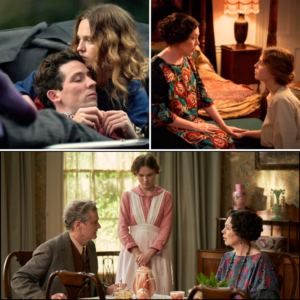
At the story’s fractured heart is Roger Winstanley, reimagined by Gatiss as a shell-shocked veteran whose nightmares mask shellshock scars. Tobias Menzies, 50, embodies this everyman unraveling with the quiet intensity that defined his turns as Prince Philip in The Crown and the calculating Black Jack Randall in Outlander. Fresh from voicing a haunted pilot in F1 and brooding through The Terror‘s second season, Menzies brings a lived-in fragility to Roger: wide-eyed boyishness curdling into middle-aged despair as the dream spans his youth to forties. “Roger’s not just dreaming; he’s foreseeing his own erosion,” Menzies told The Guardian, recounting how Gatiss layered in subtext of lost loves and battlefield guilt. Filming the dream sequences—Roger aging via subtle prosthetics and lighting shifts—demanded emotional acrobatics: one take stretched six hours, Menzies emerging “hollowed out, like the tower had claimed a piece of me.” His Roger starts as a carefree guest, laughing over croquet mallets, but each iteration sours: the family’s silence thickens, faces hollow like wartime rations, culminating in a real invitation from erstwhile schoolmate Jack Stone that drags reverie into flesh. Menzies’s masterstroke? The micro-expressions— a flicker of recognition in the dream family’s eyes, hinting at Roger’s unspoken complicity in some ancestral sin.
Opposing him is the venomous Mrs. Stone, played by Dame Joanna Lumley with the arched eyebrow of a duchess who’s dined with devils. At 79, the Absolutely Fabulous icon—whose filmography spans On Her Majesty’s Secret Service to Motherland‘s sardonic matron—infuses the role with “trademark poise masking primal hunger,” as Gatiss describes. Lumley’s Mrs. Stone isn’t a snarling crone but a vampire of Victorian vintage: elegant in pearl chokers and lace, her voice a velvet noose drawing Roger upward. “Joanna’s got that Benson bite—surface charm, subsurface fang,” Gatiss quipped during production. Lumley, drawing from her own brushes with the occult (she once hosted a séance for Sapphire & Steel), relished the decay: “She’s not evil; she’s eternal, feeding on the living’s regrets. It’s deliciously impolite.” Her scenes with Menzies crackle with unspoken menace—a tea pour that lingers too long, a smile revealing too-sharp teeth—echoing Benson’s subtle eroticism in the tower’s “intimate” horrors.
The ensemble deepens the dread: Nancy Carroll (The Crown, Father Brown) as Roger’s skeptical fiancée, whose rationalism crumbles under nocturnal whispers; Ben Mansfield (Endeavour, Sister Boniface Mysteries) as the affable yet automaton-like Jack Stone, whose boyish grin hides hollow eyes; and Polly Walker (Bridgerton, Rome), Gatiss’s Bookish collaborator, as a spectral cousin whose warnings dissolve into fog. Walker’s ethereal presence—pale as moonlight, voice echoing like wind through battlements—adds a layer of feminine fury, expanding Benson’s periphery into a chorus of the damned. Gatiss populates the house with these shades not as jump-scare fodder but as mirrors to Roger’s psyche: each aging face a reminder of time’s vampiric toll, guilt’s slow bleed.
Filmed in the Gothic splendor of Cobham Hall, Kent—a Grade I-listed Tudor pile sprawling across 150 acres of haunted parkland—the production transforms the estate into a character of creeping entropy. Built in 1580 for the Brooke family and later home to the Earls of Darnley, Cobham’s towers and tapestried halls have hosted spectral siblings before: The Crown‘s royal intrigues, Mary & George‘s Jacobean poisons, even Wild Child‘s teen hijinks. But for Gatiss, its “bone-chilling authenticity” was key—the real tower room, with its creaking oak beams and leaded casements overlooking fog-shrouded gardens, needed no set dressing. Principal photography wrapped in June 2025 amid Kent’s unseasonal gales, crews rigging fog machines to mimic Benson’s “oppressive stillness.” Cinematographer Will Nicholls (The Salisbury Poisonings) lenses in desaturated sepias, dream sequences bleeding into reality via dissolves that warp time: Roger’s reflection in a hall mirror ages mid-blink. The score, by composer Debbie Wiseman (Wolf Hall), weaves harp plucks like spider silk with dissonant strings, evoking a grandfather clock ticking toward doom. “Cobham isn’t a location; it’s alive,” Gatiss reflected. “The house remembers—every creak is a ghost auditioning for the tower.”
Gatiss’s adaptation honors Benson while honing the blade. The original’s 5,000 words balloon into a half-hour of expanded dread: Roger’s wartime flashbacks interlace the dreams, suggesting the tower as metaphor for trench-haunted minds; Mrs. Stone’s backstory unfurls via sepia photographs, revealing a suicide pact with a forbidden lover, her vampirism a curse of eternal widowhood. Gone are overt fangs—Gatiss opts for implication, the horror in what isn’t seen: a shadow elongating on the stairs, a bloodstain blooming on linen at dawn. “It’s psychological decay, not jump scares,” Gatiss insists, echoing Benson’s preface: stories to “give pleasant qualms” in the firelight. Produced by Adorable Media’s Isibéal Ballance for BBC Arts, with commissioning editor Mark Bell praising its “atmospheric treat where dream meets terrifying reality,” the film clocks in at 50 minutes—lean, like a stake through the heart.
Anticipation simmers like mulled wine laced with arsenic. Since the October 1, 2025, BBC announcement, #RoomInTheTower has trended on X, fans dissecting teasers: Lumley’s chilling line delivery in a first-look clip—”Jack will show you up; I’ve given you the room in the tower”—racking 2 million views. Podcasts like The M.R. James Podcast hail it as “Gatiss’s pivot to Benson brilliance,” while The Guardian previews warn of “sleepless Christmases.” Social whispers from Rye’s Benson society—where devotees flock annually—buzz with authenticity: “Finally, EFB’s vampire gets her due, not as monster but mourner.” Critics, sensing a tonal shift from James’s antiquarian spooks, predict Emmys for Menzies’s unraveling and Lumley’s luminous menace. In a year of reboots (Doctor Who‘s festive whimsy, Netflix’s The Haunting of Hill House sequel), The Room in the Tower stands as antidote: intimate, inevitable, a reminder that true terror whispers, never shouts.
Yet beneath the fog, questions linger. Will Gatiss’s inter-war gloss soften Benson’s Edwardian bite, or sharpen it against modernity’s ghosts—pandemic isolations, digital dreams that bleed into days? As Roger Winstanley ascends those fatal stairs, viewers may glimpse their own towers: regrets bricked up, guilts gnawing from within. In Gatiss’s hands, Benson’s chiller isn’t mere entertainment; it’s exorcism, a Yuletide unburdening where the dead demand their due. Tune in on BBC Two and iPlayer this Christmas Eve—dim the lights, pour the brandy, and brace. The room awaits, and once invited, escape is but another dream.