Shadows Over Ivy: The Brown University Incident That Exposed Cracks in Campus Security
Providence’s historic skyline, dotted with the spires of Brown University’s College Hill, usually hums with the rhythm of intellectual pursuit—students huddled in libraries, debating philosophy under gas lamps that flicker like forgotten ideas. But on December 13, 2025, that rhythm shattered in the sterile confines of Barus and Holley Hall, a engineering building known more for circuit boards than chaos. What began as a final-exam review session for 25 undergraduates in an advanced economics course spiraled into a tragedy that claimed two lives, left nine injured, and thrust the Ivy League enclave into a multi-agency manhunt now stretching into its fourth day.
The incident, unfolding around 7:15 p.m. amid the winter chill that grips Rhode Island, targeted a group of mostly sophomores and juniors cramming for assessments in Professor Miriam Goldstein’s popular seminar on behavioral economics. Goldstein, a 52-year-old tenured faculty member with a reputation for blending game theory with real-world ethics, had organized the voluntary gathering to foster collaboration—a hallmark of Brown’s open-curriculum ethos. Attendees, drawn from diverse majors like public policy, neuroscience, and computer science, represented the university’s global tapestry: international students from India and Nigeria, first-generation Americans from Boston’s suburbs, and legacy admits from New England’s elite.
Eyewitness accounts, pieced together from initial police interviews and campus security footage released December 15, paint a harrowing sequence. A figure in dark clothing and a face covering—described as a backpack-clad male in his mid-20s, approximately 5-foot-10, with a medium build—breached the unsecured side entrance of Barus and Holley around 7:10 p.m. Campus logs show no tailgating alerts triggered; the door, propped open by a forgotten textbook, offered unwitting access. The intruder navigated two flights of stairs to the third-floor seminar room, where fluorescent lights buzzed over whiteboards scrawled with supply-demand curves.
Chaos erupted within seconds. Students later recounted to Providence Journal reporters a sudden intrusion, shouts echoing off concrete walls, and a frantic scramble for cover behind overturned desks and projector carts. Goldstein, positioned at the front, attempted to de-escalate, her voice rising above the din with commands to seek shelter. “She was our anchor,” sophomore Elena Vasquez, one of the injured, shared from her bed at Rhode Island Hospital. “Professor G told us to text 911, stay low—saved more than she knows.” Emergency dispatches logged the first call at 7:18 p.m., a garbled plea from a hiding junior: “Barus Hall—intruder—hurry.”
Responders from Providence Police Department arrived within four minutes, their sirens piercing the dusk as tactical units cordoned off Thayer Street, Brown’s bustling artery lined with cafes and bookstores. Brown Public Safety officers, augmented by Rhode Island State Police helicopters overhead, locked down the 260-acre campus—home to 7,000 undergrads and 2,500 grads—evacuating dorms like Keeney Quadrangle and Pembroke Hall. By 8 p.m., the perimeter expanded to include nearby Wayland Square, with K-9 units sweeping green spaces and door-to-door canvasses in historic homes.
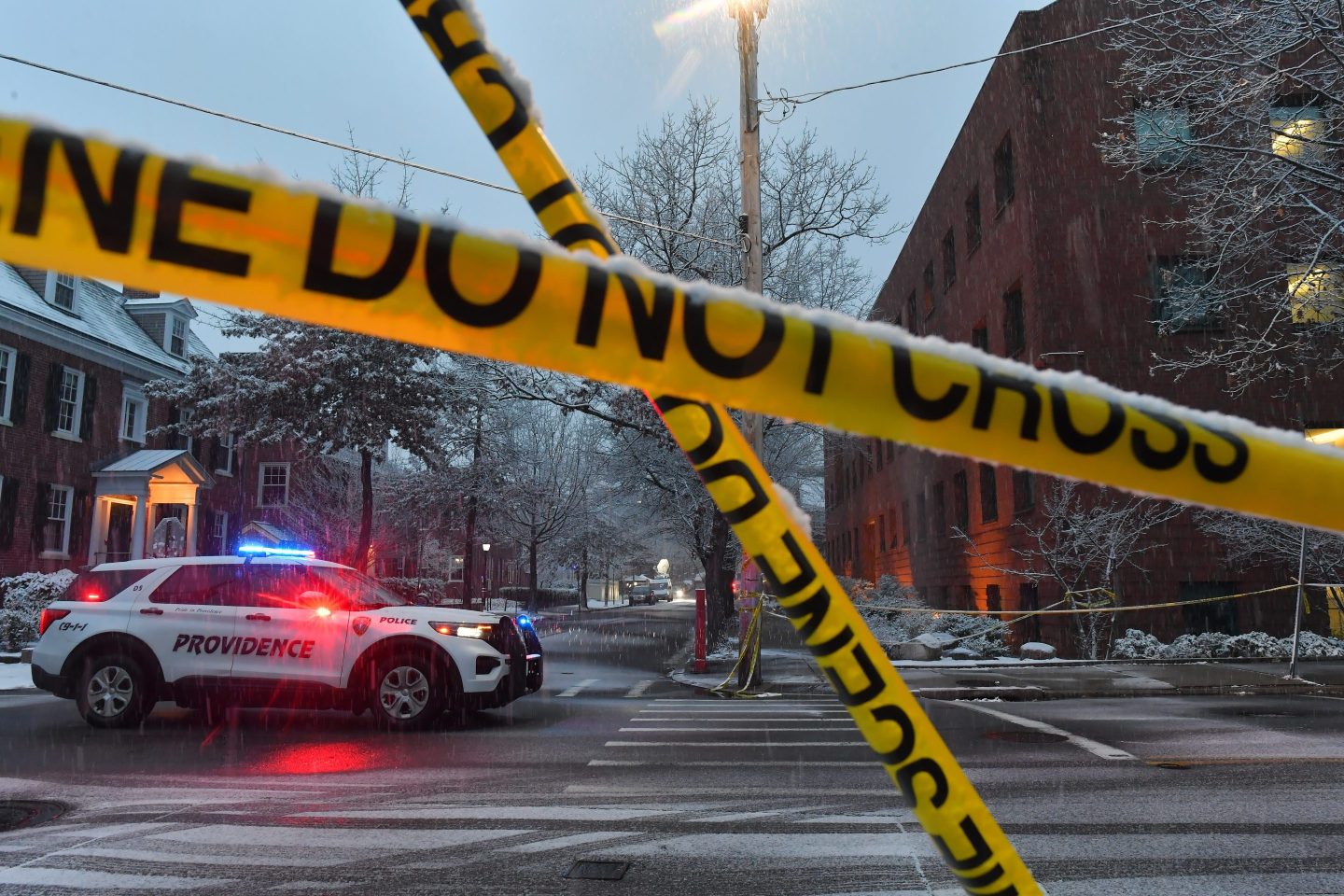
The toll emerged in fragments: Two fatalities confirmed by 9:30 p.m.—identified December 14 as 20-year-old Amir Khan, a Pakistani-American computer science major from Queens, New York, and 21-year-old Sofia Ramirez, a Mexican heritage studies concentrator from Los Angeles. Khan, remembered by roommates as a coding whiz who volunteered at local coding bootcamps for underserved youth, succumbed to injuries at the scene despite CPR from fellow students. Ramirez, a vocal advocate for immigrant rights through Brown’s Swearer Center, fought for two hours in surgery before passing; her family released a statement praising her “fierce spirit that lit every room.” Nine others, aged 19 to 23, suffered non-life-threatening wounds—fractures, lacerations, and concussions—treated at three area hospitals: Rhode Island, Miriam, and Women & Infants. All were reported stable by December 16, with discharge expected over the holiday break.
The intruder’s escape route, traced via fragmented CCTV from adjacent buildings, led eastward through the Van Wickle Gates—Brown’s iconic wrought-iron portal symbolizing academic passage—toward Benefit Street’s colonial facades. A grainy still, disseminated by FBI Boston on December 15, captures the figure glancing back at 7:22 p.m., backpack slung low, gait purposeful amid scattering pedestrians. No vehicle was recovered, but traffic cams near the Providence River flagged a dark sedan speeding away minutes later. “We’re dealing with a calculated actor,” Providence Police Chief Angelo Parisi stated at a December 14 presser, flanked by Brown President Christina Paxson. “This wasn’t impulse; planning shows in the evasion.”
A brief lead—a 24-year-old Wisconsin native detained December 14 after a tip linked his rental car to campus sightings—fizzled by evening. Released without charges, the individual, a former URI student visiting friends, cooperated fully but alibied out via timestamped receipts from a Federal Hill pizzeria. “Wrong place, wrong time for him,” quipped Rhode Island Attorney General Peter Neronha, who vowed no stone unturned in the joint task force now involving 300 personnel.
FBI Director Kash Patel, addressing the crisis from Quantico on December 15, announced a $50,000 reward for tips leading to identification and apprehension. “The Bureau’s full arsenal—behavioral analysis, digital forensics, evidence response teams—is deployed,” Patel said in a video statement viewed 2 million times on X. “From Quantico labs tracing trajectories to street agents pounding pavement, we’re all in.” The offer, pooled from federal coffers and private donors including Brown’s alumni network, generated over 400 calls to the tipline (1-800-CALL-FBI) by midday December 16, sifting through false alarms and earnest leads.
Brown’s response crystallized the university’s dual role as sanctuary and sentinel. President Paxson, a soft-spoken economist with a track record in crisis management from the 2016 campus protests, canceled finals through December 20, shifting to pass/fail for affected courses. Counseling hubs popped up in Sayles Hall and the Quiet Green, staffed by 50 therapists from the Brown/Rhode Island Hospital partnership; walk-ins tripled, with grief circles for international students navigating visa anxieties amid the lockdown. “Our community is resilient, but raw,” Paxson emailed the student body December 14. “This breach tests us, but together we rebuild stronger.”
Financially, the hit is steep: Preliminary estimates peg property damage at $150,000—smashed windows, bloodied carpets in Barus and Holley—plus $2 million in security upgrades announced December 15. These include AI-monitored doors, expanded camera grids (up 40% campus-wide), and mandatory badge swipes for all buildings post-6 p.m. Brown’s endowment, a robust $7.2 billion, cushions the blow, but donors like hedge fund titan Ray Dalio pledged $1 million for a “Safety Innovation Fund” during a virtual town hall December 16, attended by 4,000.
The human mosaic of loss deepens the wound. Khan’s family, flying in from New York, held a private memorial in the Sarah Doyle Center, where his mother, a MTA clerk, clutched his laptop etched with “Code for Change.” Friends launched a GoFundMe surpassing $300,000 for scholarships in his name, highlighting his open-source contributions to AI ethics projects. Ramirez’s tribute trended under #SofiaShines: Vigils at the Main Green featured luminarias spelling her favorite quote from Gloria Anzaldúa—”Nothing’s going to change unless we do it.” A junior from her concentration, Diego Morales, told NPR, “She pushed us to question power structures; now she’s questioning from above.”
Speculation simmers on motives, fueled by the seminar’s eclectic roster. Goldstein’s course, “Economics of Inequality,” delved into wealth gaps and social mobility—topics that drew vocal debaters, including Khan, who blogged on algorithmic bias, and Ramirez, who co-authored a paper on migrant labor markets. Whispers on Reddit’s r/BrownU and X threads point to ideological friction: One anonymous post claimed the intruder muttered phrases tied to anti-elite sentiments, though unverified. U.S. Sen. Tommy Tuberville (R-Ala.), in a December 15 Fox News hit, referenced unconfirmed reports of “targeted rhetoric,” urging a probe into campus “divisive dialogues.” Conversely, Sen. Jack Reed (D-R.I.), Brown’s home-state champion, called for unity: “Politicizing pain dishonors the fallen.”
Broader currents amplify the unease. Campuses nationwide, from Harvard’s 2023 congressional grillings to Columbia’s 2024 protest clashes, grapple with free speech versus safety. Brown’s incident—its first major breach since a 1991 dorm scuffle—spotlights vulnerabilities: A 2025 Everytown report ranked Ivy League schools middling on active threat drills, with only 60% of students trained in evasion tactics. “Open access is our DNA,” Public Safety Director Elena Torres explained to The Chronicle of Higher Education. “But post-pandemic, we’ve lagged on tech integration—budget reallocations favored scholarships over surveillance.”
National ripple effects mount. The Department of Education, under Secretary Miguel Cardona, dispatched a rapid-response team December 14 to audit Brown’s compliance with Clery Act reporting—mandating timely crime alerts. “No institution is immune,” Cardona tweeted, linking to resources for 4,000 colleges. On Capitol Hill, Rep. Virginia Foxx (R-N.C.), House Education Chair, scheduled hearings for January 2026: “The Briarwood Debacle [a 2024 Michigan State event] was a warning; Brown’s a siren.” Advocacy groups like Moms Demand Action rallied 500 outside the Rhode Island State House December 15, banners reading “Protect Our Campuses—Now.”
Student voices cut through the din. The Brown Daily Herald, the nation’s third-oldest college paper, published a December 16 op-ed by editor-in-chief Lila Chen: “We’ve debated safe spaces; now we demand them.” Protests—peaceful marches from Faunce House to the Rock—called for faculty-led security reviews, drawing 1,200 by evening. International contingents, comprising 20% of undergrads, voiced amplified fears: Khan’s roommate, Nigerian engineering major Tunde Adebayo, told BBC, “Visas tie us here, but safety? That’s the real border.”
As December 16 dawned gray, the manhunt pulsed with fresh vigor. FBI behavioral profilers, drawing on 500 similar cases, peg the suspect’s profile: Likely local or regional, with grudges against “elite” institutions, possibly amplified by online echo chambers. Door knocks in Pawtucket and canvasses in East Providence yielded CCTV pings—a matching silhouette at a bus depot December 14—but no collar. “Persistence pays,” quipped lead investigator Lt. Maria Santos at a 10 a.m. update. “Every eye, every ear—your tip could close this.”
Healing flickers amid the hunt. Brown’s chapel hosted interfaith services December 15, blending Catholic masses with Muslim salat and Jewish havdalah—echoing the seminar’s diversity. Alumni poured in: A virtual fundraiser by the Brown Annual Fund hit $5 million by noon December 16, earmarked for trauma grants. Goldstein, bandaged but unbowed, addressed her class via Zoom: “Economics teaches scarcity; today, we affirm abundance—of care, of community.”
Experts like Dr. Raj Patel, a crisis psychologist at URI, frame the path forward. “Acute grief morphs to collective resolve,” he noted in a CNN panel. “Brown’s agility—its flat hierarchy—positions it for pioneering reforms, like peer-reporting apps tested at Yale.” Data backs optimism: Post-incident surveys from Virginia Tech (2007) show 85% of survivors reporting heightened purpose a year on.
Yet shadows linger. As finals fade and breaks beckon, questions gnaw: Why Barus and Holley, a low-traffic node? Was the propped door negligence or oversight? And in an era of polarized discourse, does Brown’s vaunted openness invite peril? Paxson, in a December 16 op-ed for The Atlantic, pondered: “Knowledge thrives in vulnerability; now we fortify without walls.”
Providence’s bells toll midnight December 16, a somber knell over College Hill. The gates, once portals to promise, stand sentinel—barred, but not broken. For Khan and Ramirez, legacies etch in code and critique; for survivors, scars forge steel. The hunt endures, a testament to tenacity: In the face of fracture, Brown binds tighter, illuminating paths from darkness to dawn.