There he was, pedaling lazily down the sun-dappled streets of Santa Monica, a loyal golden retriever trotting alongside like an old confidant. Tate Donovan, the boyish heartthrob who once set pulses racing in the neon glow of 90s Hollywood, looked every bit the part of a man who’d traded red carpets for real life. At 62, his dark hair streaked with silver, clad in a rumpled plaid flannel shirt tucked into faded Levi’s, he could have been any weekend warrior escaping the city’s hum. No entourage, no flashing bulbs—just the salty Pacific breeze ruffling his collar and a quiet smile that hinted at secrets buried deep. Paparazzi caught the moment on a crisp December afternoon, a snapshot that bridged decades: the Hercules voice actor, the Friends charmer, the ex of two queens—Jennifer Aniston and Sandra Bullock—now content in anonymity.
It’s a far cry from the whirlwind of the mid-90s, when Donovan was the golden boy of Tinseltown, his easy grin lighting up screens from Disney animations to George Clooney’s ensemble casts. But that sighting? It stirred something nostalgic, a reminder that the men who wooed our icons aren’t footnotes; they’re flesh and blood, carrying the weight of romances that shaped pop culture. Donovan’s love stories with Aniston and Bullock weren’t just tabloid fodder—they were the stuff of era-defining fairy tales, laced with chemistry, heartbreak, and the kind of awkward overlaps that make Hollywood feel like a small-town soap opera. And in a 2020 chat that went viral for its cheeky candor, the two women themselves spilled the tea, turning their shared ex into a punchline that still lands like a velvet hammer.
Flash back to 1992, a year when grunge ruled the airwaves and Hollywood was churning out rom-coms faster than Blockbuster could stock them. Tate Donovan, fresh-faced at 29, arrived on the set of the indie rom-com Love Potion No. 9 with the unassuming swagger of a theater kid who’d hustled from New Jersey stages to silver screens. He’d already notched credits in SpaceCamp (1986), where he played a plucky teen astronaut, and Clean and Sober (1988), rubbing shoulders with Michael Keaton in a gritty addiction drama that earned him early buzz. But it was Love Potion No. 9—a quirky tale of awkward scientists peddling aphrodisiacs—that introduced him to Sandra Bullock, the brunette firecracker who was about to explode into stardom.

Bullock, then 28 and still grinding through bit parts in Demolition Man and The Vanishing, wasted no time. “I chased him like a dog,” she confessed years later in a 1995 Vanity Fair profile, her laughter bubbling with that infectious mix of self-deprecation and steel. “I adored Tate so much. There’s nobody that means more to me.” Their meet-cute was pure rom-com serendipity: chemistry tests that crackled off-screen, leading to a first date where, as Donovan later recounted to People, “All we did was talk about our relationships.” He was reeling from a recent split; she was navigating the cutthroat audition circuit. By night’s end, they were inseparable, two mirrors reflecting each other’s vulnerabilities—talented, funny, kind, introspective, generous, as Bullock would poetically sum it up decades later.
For four blissful years, from 1992 to 1996, Donovan and Bullock were Hollywood’s under-the-radar power couple. They kept it low-key, far from the prying eyes that would soon swarm Bullock after Speed (1994) catapulted her to A-list orbit. That Keanu Reeves blockbuster wasn’t just a box-office smash—grossing over $350 million worldwide—it was the rocket fuel for Bullock’s ascent, turning her from quirky sidekick to every guy’s dream girl. Donovan, ever the supportive partner, watched from the wings, proud but perhaps a tad overshadowed. “We were like a mirror of each other,” he reflected in a 1997 TV Guide interview, his voice warm with fondness. Their downtime was simple: long drives up the coast, late-night script reads, and dreams of building something real amid the fakery.
But timing, that cruel Hollywood director, had other plans. The couple split in 1994, right as Speed‘s adrenaline-fueled romance scenes hit theaters. No dramatic blowout, no infidelity scandals—just the quiet erosion of two ambitious souls pulling in different directions. Bullock threw herself into work, landing While You Were Sleeping (1995) and A Time to Kill (1996), roles that solidified her as the era’s rom-com queen. Donovan, meanwhile, licked his wounds in relative privacy, channeling the ache into his craft. Looking back, Bullock’s words in that Vanity Fair piece carry a poignant hindsight: “He seems to have a type,” she’d say of Donovan’s future flames, but in the moment, the breakup stung like salt in a fresh script rewrite.
Enter Jennifer Aniston, stage left, in the sticky summer of 1995. Donovan, nursing his post-Bullock blues, met the Friends star through mutual pals in New York’s bustling theater scene. He was oblivious to her sitcom supernova status—”I’d never seen Friends!” he admitted sheepishly to People in 2024—drawn instead to her quick wit and that effortless California cool. Aniston, 26 and riding the wave of Friends‘ second-season surge, saw in Donovan a grounded counterpoint to the chaos of sudden fame. Their first date? A disaster movie in the making. Paparazzi swarmed their second outing, flashbulbs popping like gunfire. “I was like, ‘I’m out of here,'” Donovan recalled, the memory still eliciting a wry chuckle. Fame’s glare had chased him once; he wasn’t eager for an encore.
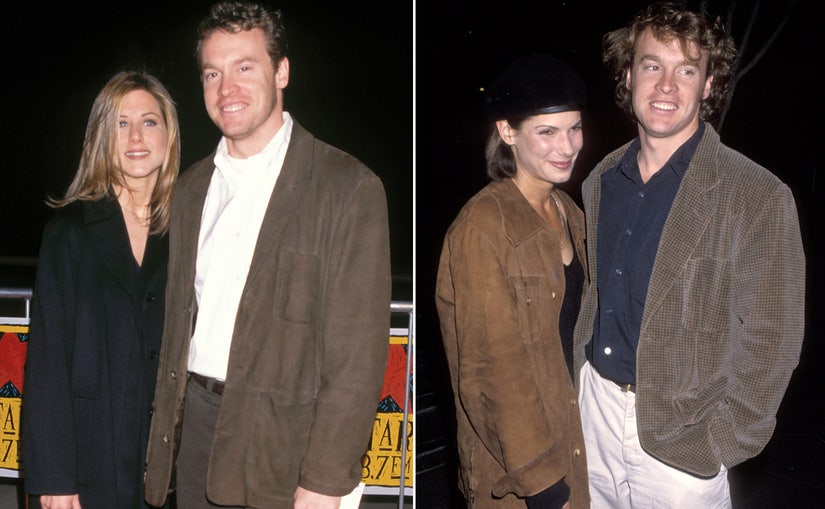
Yet, against the odds, sparks flew. For over two years, from 1995 to 1998, Donovan and Aniston were that rare Hollywood pairing: cohabiting in a cozy New York brownstone, far from L.A.’s viper pit. They cooked pasta in cramped kitchens, strolled Central Park hand-in-hand, and whispered dreams of normalcy amid the roar of Friends‘ Thursday-night dominance. Aniston, the queen of relatable glamour, found in Donovan a partner who matched her humor beat for beat. “Tate’s and my breakup had nothing to do with ego battles, wanting babies, not wanting marriage … none of it was accurate,” she clarified in a raw 1999 Rolling Stone interview, debunking tabloid myths of wealth gaps or power plays. The truth was simpler, sadder: clashing worlds. Donovan, the suburban New Jersey boy at heart, craved roots; Aniston, the quintessential New York City girl, thrived on the city’s electric pulse.
Their split in early 1998 hit like a plot twist no one saw coming—least of all the Friends writers. Donovan had already been cast as Joshua Burgin, Rachel Green’s (Aniston’s character) architect boyfriend, in Season 4. Filming commenced mere months after the breakup, turning the set into a minefield of awkward glances and unspoken grief. “It was really painful and tough,” Donovan confessed to The Independent in a candid 2024 sit-down, his voice cracking just a fraction. The cast, that tight-knit family forged in laugh-track fires, rallied around them. Matthew Perry, the late funnyman whose wit masked his own battles, emerged as Donovan’s quiet champion. “He was such a champion of mine,” Donovan shared with People. “He was the only one who called me when me and Jen broke up. … I was really heartbroken.” Perry’s check-ins—simple, no-frills calls—were lifelines in the emotional rubble.
The on-screen romance mirrored their real one with eerie precision: Joshua, the charming everyman, woos Rachel with rooftop kisses and quirky charm, only to fade into the ensemble. Fans, blissfully unaware, shipped “Rachoshua” with fervor, blind to the real tears behind the takes. Aniston powered through with her trademark poise, but off-camera, the strain showed in fleeting shadows. Donovan, ever the pro, delivered lines with a smile that didn’t quite reach his eyes. “We requested that we limit our interactions,” he revealed, a detail that humanizes the gloss of stardom. It was Friends at its most meta: a show about messy love playing out its own backstage drama.
Fast-forward to 2020, and the universe, with its impeccable comic timing, gifted us the gift that keeps on giving: a Interview magazine roundtable where Bullock and Aniston, now eternal besties, dissected their shared romantic history with the grace of old sorority sisters swapping war stories. Moderated by their The Morning Show co-star Reese Witherspoon, the chat was a masterclass in Hollywood sorcery—witty, warm, and wickedly revealing. Bullock, ever the instigator, dropped the bomb: “We were introduced by our former boyfriend. I say ‘our’ because you and I both partook of this one human being.” Aniston, quick as a whip, volleyed back: “Yes, we did. That’s a beautiful way of saying it.” Laughter erupted, but beneath it lay a tender truth. Bullock, reflective at 56, added, “He seems to have a type: Talented. Funny. Kind. Introspective. Generous.” It was a toast to Donovan, not a takedown—a rare moment where exes become allies, turning potential shade into shimmering nostalgia.

That exchange went supernova, racking up millions of views and spawning memes that painted Donovan as the ultimate 90s catch: the guy who snagged two rom-com royals and lived to tell (or not tell) the tale. Social media lit up with “Tate Donovan effect” threads, fans dissecting his type—brunettes with backbone, laughs that linger, hearts as big as their talent. It humanized the icons: Aniston, post-Pitt (2000-2005) and Theroux (2015-2017), now blissfully Instagram-official with longtime beau Jim Curtis as of November 2025, her feed a sunlit scroll of dogs, scripts, and subtle joy. Bullock, widowed since photographer Bryan Randall’s quiet passing in July 2023 after a private ALS battle, has kept her heart guarded but open. “I’m open to love again,” she hinted in a 2024 People interview, her smile a defiant bloom amid grief. At 61, she’s the matriarch of feel-good flicks like The Lost City (2022), proving time only sharpens her sparkle.
And Donovan? He’s the enigma who slipped the spotlight’s noose. Post-Friends, his career zigzagged with indie grit and TV steadiness: a full arc as the flawed dad Jimmy Cooper on The O.C. (2003-2007), earning him a Teen Choice nod; Emmy-buzzed turns in Damages (2007-2010) opposite Glenn Close; and scene-stealing support in Clooney’s Good Night, and Good Luck (2005) and Ben Affleck’s Argo (2012). Voice work kept him iconic—his Hercules in Disney’s 1997 smash remains a cultural touchstone, that booming baritone belting “Zero to Hero” to generations. Yet, he’s always been the “that guy” actor: memorable without the marquee madness, a chameleon who thrives in the ensemble.
Life off-screen mirrors that balance. Married twice—first to writer Corinne Kingsbury (2005-2008), a union that produced no kids but plenty of creative sparks; then to yoga instructor Corry Scheuerman in 2015, a low-key love that’s weathered a decade without the tabloid glare. No scandals, no tell-alls—just steady roles in procedurals like House and Goliath, and the occasional theater gig that calls him back to his Jersey roots. That Santa Monica bike ride? It’s emblematic: a man at peace, dog at heel, fame a distant echo.
But let’s peel back the glamour—what does it mean to be the bridge between two titans? Donovan’s stories, sprinkled across interviews like confetti, paint a portrait of vulnerability wrapped in valor. With Bullock, it was passion unchecked: stolen kisses on set, dreams of a life beyond scripts. “She pursued me, and I was done for,” he quipped in a 1995 Us Weekly, his eyes twinkling with the memory of her relentless charm. Their split? A gentle unraveling, timed cruelly with her ascent. “I was happy for her success, but it highlighted our paths diverging,” he admitted in 2024, a nod to the quiet ache of loving someone who outgrows your shared orbit.
Aniston’s chapter was deeper, more domestic—the brownstone breakfasts, the late-night laughs over Seinfeld reruns. “Jen was my rock in a storm I didn’t see coming,” Donovan told The Independent, alluding to the post-Bullock haze. Yet, fame’s intrusion foreshadowed the end: that paparazzi ambush on date two, a harbinger of the scrutiny that would chase Aniston into Friends mania. The breakup’s fallout on set was sitcom gold wrapped in tragedy—Donovan’s Joshua episodes (1998) now binge-watched relics, laced with unintended pathos. “Every take felt like therapy,” he reflected, crediting Perry’s calls as “the only light in that tunnel.”
Hollywood’s dating hall of fame is littered with such overlaps—think DiCaprio’s revolving door or Clooney’s pre-Amal escapades—but Donovan’s tale stands apart for its lack of venom. No shade thrown, no revenge tours. Instead, that 2020 trio chat: Aniston and Bullock, arms linked in solidarity, toasting their “one human being” with affection. It’s the anti-scandal, a blueprint for exes who evolve into elders. “We laugh about it now,” Aniston said in the interview, her voice a balm. “Tate was magic. We were lucky.”
In 2025, as Donovan coasts through his sixth decade on a Santa Monica bike, the 90s feel like a fever dream—Speed‘s bus chases, Friends‘ coffeehouse quips, Hercules’ triumphant roar. Yet his story lingers, a reminder that behind the icons are ordinary hearts, bruised but beating. Aniston, 56 and radiant in her post-divorce glow, embodies the rom-com heroine who gets the sequel: Curtis, her steady since 2018, a producer who lets her shine sans spotlight. Bullock, 61 and fiercely private, honors Randall’s memory through her quiet philanthropy, her next project—a gritty drama with Margot Robbie—hinting at reinvention.
Donovan? He’s the unsung hero, the everyman who loved fiercely and let go gracefully. That dog-eared flannel sighting? It’s not retreat; it’s reclamation. In a town that devours its darlings, he’s proof you can exit stage left and still hear applause. As he pedals into the sunset—literal and figurative— one can’t help but wonder: If life were a script, would Tate Donovan pen a happy ending? From the looks of it, he already has.