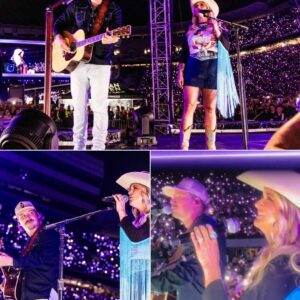
NASHVILLE, TN – June 7, 2025, will go down in country music lore as the night Nissan Stadium shed its NFL polish and morphed into the rowdiest, boot-scootin’ honky-tonk this side of the Mississippi. Under a canopy of thumping bass and swirling stage lights, Blake Shelton—country’s resident fun-loving everyman—summoned his towering, deep-voiced comrade Trace Adkins for a surprise duet of their 2009 chart-topper “Hillbilly Bone.” What unfolded wasn’t just a performance; it was a full-throttle revival, a playful duel of baritone bravado that had 80,000 fans hollering “yee-haw!” in unison, proving that in the heart of Music City, nothing unites a crowd like a good-natured romp celebrating the wild, unapologetic spirit of the South. Shelton, the 49-year-old Oklahoma charmer with a grin wider than the Cumberland River, and Adkins, the 63-year-old Louisiana giant whose voice rumbles like thunder over bayou waters, fed off each other’s energy like two old tomcats squaring off in a friendly scrap. With its infectious beat, cheeky lyrics, and zero pretense, the anthem transformed the sprawling stadium into an irresistible party where strangers became sing-along soulmates, hats flew skyward, and for one glorious hour, the weight of the world dissolved into pure, foot-stomping joy.
CMA Fest, the self-proclaimed “Music Event of Summer” presented by SoFi, has been Nashville’s crown jewel since 1972, evolving from a modest fan gathering into a four-day juggernaut that pumps over $50 million into the local economy. Spanning June 5-8 in 2025, the 52nd edition drew a record-breaking 90,000-plus daily attendees to the banks of the Cumberland, where the air hung thick with the sizzle of food trucks slinging hot chicken and funnel cakes, and the hum of over 30 stages echoed from Riverfront Park to the neon-drenched chaos of Lower Broadway. By day three—Saturday, the weekend’s fever pitch—the city pulsed like a living organism, with pop-up gigs in honky-tonks like Tootsie’s and the Hard Rock Cafe spilling talent onto sidewalks teeming with cowboy boots and bedazzled denim. But the night’s true heartbeat thrummed inside Nissan Stadium, the 69,000-seat behemoth transformed into a coliseum of country with massive LED screens, pyrotechnic bursts, and a stage flanked by faux hay bales and flickering lanterns evoking a backwoods barn dance. Headliners like Jason Aldean, Lainey Wilson, Keith Urban, and Megan Moroney had already whipped the masses into a frenzy earlier in the evening, but when Shelton’s set hit its stride around 9 p.m., the energy shifted to something more primal, more communal—a throwback to the genre’s rowdy roots.
Shelton, born Blake Tollison Shelton on June 18, 1976, in the small Oklahoma town of Ada, has always been the blue-collar bard who makes stardom feel attainable. Raised on a family cattle ranch where his father managed the local tire store and his mom dreamed of showbiz, young Blake learned the value of hard work and heartfelt tunes early. Tragedy struck in 1990 when his half-brother Richie died in a car accident, a loss that infused his songwriting with a quiet depth beneath the humor. He burst onto the scene in 2001 with his self-titled debut album’s lead single “Austin,” a tender tale of lingering love that held the No. 1 spot on the Billboard Hot Country Songs chart for five weeks—the longest run by a debut artist at the time. Over two decades, Shelton has amassed 28 No. 1 hits, sold more than 12 million albums, and become a household name as a coach on The Voice since 2011, where his easygoing wit and coaching prowess earned him nine wins. Offstage, he’s the guy who owns the Ole Red bar chain (now with spots in Nashville, Tulsa, and Gatlinburg), hunts deer on his sprawling Oklahoma ranch, and married pop icon Gwen Stefani in 2021, blending their families into a quirky clan complete with goats and grandkids. His 2025 album For Recreational Use Only, a return to his rowdy roots after the introspective Texoma Shore, features tracks like “Stay Country or Die Tryin’,” a defiant ode to authenticity that he teased solo earlier in the set, strumming his acoustic with that signature backward cap perched jauntily.

But Shelton’s secret sauce has always been collaboration, and few pairings crackle like his bromance with Trace Adkins. Adkins, born Tracy Darrell Adkins on January 13, 1962, in Sarepta, Louisiana—a speck of a town where oil rigs outnumbered stoplights—grew up chopping cotton on his family’s farm and dreaming of rodeo glory. A towering 6’6″ frame (earned from a growth spurt that left him ducking doorways) and a bass voice honed in Baptist choirs set him apart early. Tragedy shadowed him too: at 17, a near-fatal gunshot wound to the heart during a bar scuffle sidelined his logging career and pivoted him to music. By 1996, after stints in oil fields and as a commercial fisherman in Alaska, he landed a Capitol Nashville deal, debuting with “If I Fall, You’re Goin’ Down with Me” from his self-titled album. Adkins’ career exploded with hits like “Ladies Love Country Boys” and “Honky Tonk Badonkadonk,” the latter a 2005 crossover smash that peaked at No. 2 on the Hot Country Songs chart and introduced his gravelly growl to pop audiences. With 11 studio albums, a Grammy nomination for “Just Fishin'” with his daughter, and roles in films like The Lincoln Lawyer, Adkins embodies the rugged romantic—equal parts tender dad and tough-as-nails troubadour. He’s survived throat cancer (diagnosed in 2005), a brain hemorrhage in 2020, and the cutthroat Nashville machine, all while raising five daughters and advocating for veterans through his work with the Wounded Warrior Project.
Their friendship? Forged in the fire of shared stages and late-night laughs. Shelton idolized Adkins growing up, sneaking into his early shows as a teen. By 2008, they co-headlined the Honky Tonk Badonkadonk Tour, a rowdy affair that sold out arenas and spawned endless backstage yarns. “Trace is like the big brother I never had—except he steals my beer and tells worse jokes,” Shelton quipped in a pre-fest radio spot on Nashville’s WSIX-FM. Adkins, ever the straight man, fired back: “Blake’s the little brother who thinks he’s funny. But damn if he don’t sing like an angel with a hangover.” Their chemistry birthed “Hillbilly Bone,” penned by Luke Laird, Craig Wiseman, and Ronnie Dunn of Brooks & Dunn fame, and released as the lead single from Shelton’s fourth album Hillbilly Bone in October 2009. The track—a foot-stompin’ declaration that “we all got a hillbilly bone down deep inside”—topped the Hot Country Songs chart for four weeks, crossed over to No. 55 on the Hot 100, and earned platinum certification. Its video, a riotous romp through a faux trailer park with cameos from Dunn and Reba McEntire, captured the song’s essence: unpretentious pride in one’s roots, no matter if you’re from the holler or the high-rise. Over the years, they’ve dusted it off for encores on Shelton’s Friends and Heroes Tour (where Adkins was a staple opener) and surprise drops at the ACM Awards, each time reigniting its rowdy magic.
Saturday’s stadium set was vintage Shelton: kicking off with a high-octane “God’s Country,” the 2019 Grammy-nominated powerhouse that had the crowd waving phone lights like fireflies in a July jar. Dressed in his uniform of distressed jeans, a black button-down rolled to the elbows, and that ever-present Kubota cap, he prowled the stage like a man half his age, bantering with fans about their “hillbilly camouflage” outfits. Midway through, as the sun dipped behind the stadium’s halo of screens flashing fan selfies, Shelton paused, mic in hand, sweat beading under the spots. “Y’all, they told me tonight I could do whatever the hell I wanted,” he drawled, his Oklahoma twang drawing whoops. “And I’ve got one secret weapon up my sleeve—one of my best friends in the world, a man who’s forgotten more hits than most remember. Ladies and gentlemen, give it up for the one, the only… Trace freakin’ Adkins!”
The roar was deafening, a seismic wave that rippled through the stands as Adkins lumbered onstage—6’6″ of pure presence in a crisp white shirt tucked into Wranglers, his trademark ponytail swinging like a pendulum. No intro needed; the duo locked eyes, shared a fist-bump that lingered into a half-hug, and dove straight into Adkins’ 2005 banger “Honky Tonk Badonkadonk.” Adkins’ bass bellowed the opening lines—”Got it goin’ on like Donkey Kong / And ooh-wee, shut my mouth, slap your grandma”—while Shelton shadow-danced behind him, hyping the crowd with air guitar riffs. The stadium erupted, sections of fans (organized by color-coded wristbands for that night’s SoFi-sponsored wave) jumping in sync, the bass thumping through chests like a second heartbeat. Adkins, marking the song’s 20th anniversary, milked every growl, his voice dipping to subterranean lows that vibrated the Jumbotron. Shelton jumped in on the chorus, their harmonies a perfect push-pull—Adkins’ depth anchoring Shelton’s playful soar—turning the crossover hit into a communal chant that echoed off the river.
But the real fireworks ignited when they segued into “Hell Right,” their 2019 collab featuring Pistol Annies’ Ashley Monroe, a beer-soaked party starter that had the pit moshing like it was a rock fest. Then, without warning, the band—Shelton’s crack ensemble of fiddle virtuoso J.T. Corenflos, pedal steel wizard Deanie Richardson, and drummer Matt Chamberlain—dropped into the familiar chug of “Hillbilly Bone.” The intro riff hit like a shotgun blast, guitars twanging with that classic neotraditional bite, drums pounding a rhythm that begged for line-dancing. Shelton grabbed the mic stand, leaning into it like a barroom confessional: “No matter where you from, you just can’t hide it / When the band starts bangin’ and the fiddle sobs…” Adkins countered from stage left, his bass booming the response: “You can’t help but hollerin’ ‘yee-haw!'” Their voices clashed and complemented in glorious duel—Shelton’s light-hearted twang trading barbs with Adkins’ thunderous timbre, each verse building like a bonfire fed by moonshine logs.
The crowd? Transfixed, then transported. Tens of thousands—families with kids hoisted on shoulders, groups of college coeds in fringe jackets, grizzled vets in faded camo—surged forward, singing every word like a national anthem for the everyman. Hats sailed onto the stage like confetti; beer cups raised in salute. In the upper decks, where the cheap seats offered a bird’s-eye view of the human sea, fans linked arms for an impromptu wave that circled the bowl thrice. Down in the pit, a mosh of good-natured chaos: cowboy boots stomping divots into the turf, laughter bubbling over the roar. “It’s that song that reminds you why you’re here,” said Sarah Jenkins, a 32-year-old nurse from Knoxville who’d driven six hours solo, her voice hoarse post-set. “Blake and Trace make you feel like you’re at a backyard barbecue, not a stadium gig.” The energy fed back onstage—Shelton mugging for the cameras, Adkins towering over him like a benevolent giant, both men grinning ear-to-ear as they hit the chorus: “Ain’t nothin’ wrong, just gettin’ on / Your hillbilly bone-ba-bone-ba-bone-bone!”
As the final fiddle wail faded, the duo didn’t bow out gracefully. Instead, they milked the applause, Shelton draping an arm around Adkins’ shoulder for a mock-serious toast: “To all y’all hillbillies out there—stay country, or die tryin’!” Adkins rumbled a laugh that shook his mic, adding, “And if you ain’t got a bone, borrow one from Blake—he’s got plenty.” The stadium thundered its approval, fireworks bursting overhead in red-white-and-blue salute, while confetti cannons rained silver shreds that caught the lights like falling stars. Backstage, amid high-fives from openers like Ella Langley and Riley Green (who’d warmed the crowd with their flirty “You Look Like You Love Me”), Shelton posted a blurry selfie to Instagram: him and Adkins, arms slung around each other, captioned “Hell of a night with my brother from another mother. #HillbillyBone #CMAFest.” It racked up 2 million likes in hours, fans flooding comments with pleas for a full tour reunion: “Take this show on the road!” and “Y’all just made my summer!”
The performance’s ripple extended far beyond the stadium walls. Clips from CMA’s official YouTube channel—titled “Blake Shelton and Trace Adkins – ‘Hillbilly Bone’ | CMA Fest 2025″—exploded to 10 million views in a week, splicing fan reactions with slow-mo shots of the duo’s playful shoulder-checks. TikTok erupted with stitches: users in trucker hats lip-syncing the chorus from their living rooms, dueting with pets dubbed “hillbilly hounds.” On X, #HillbillyBoneRevival trended nationwide, with posts from alums like Deana Carter (who joined them for a quick “Strawberry Wine” tease) and even non-country stars like Post Malone chiming in: “These two just made me wanna grow a beard and learn the fiddle 😂.” Radio stations from coast to coast looped the live cut, boosting streams of the original by 300%, and Shelton’s For Recreational Use Only climbed back into the Top 10 on iTunes. For Adkins, fresh off his 2024 album Ain’t Overdue, it was a timely jolt, reminding fans of his enduring fire amid whispers of a memoir deal.
In an era where country grapples with its identity—balancing TikTok twang with traditional torchbearers—Shelton and Adkins’ romp was a defiant love letter to the genre’s beating heart. “Hillbilly Bone” isn’t just a song; it’s a manifesto: embracing the quirks, the twang, the unfiltered joy that binds us, whether you’re sipping sweet tea in Tulsa or craft beer in Brooklyn. That night in Nashville, as the stadium lights dimmed and fans spilled onto Broadway for post-show revelry—line-dancing in the streets, toasting with Jack and Cokes—they carried that spirit home. Sometimes, all you need is two old friends, a thumping beat, and a bone-deep reminder: in country music, the party’s always just getting started. Yee-haw, indeed.